From the category archives:

Ungulates

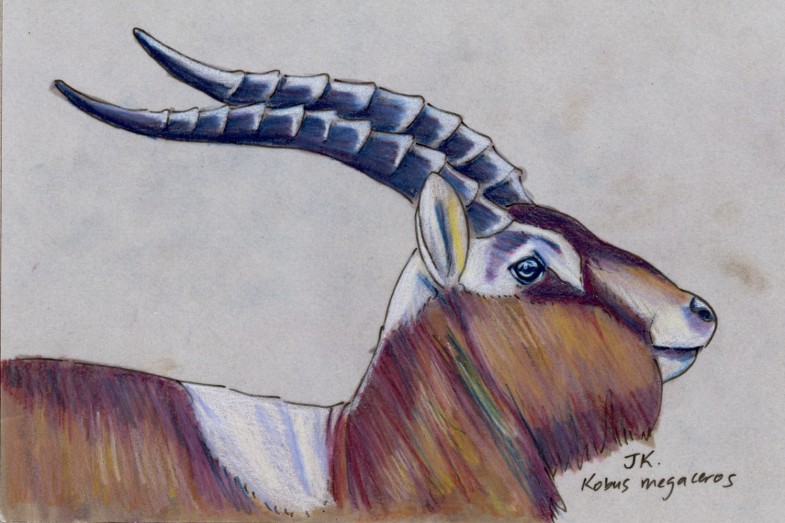
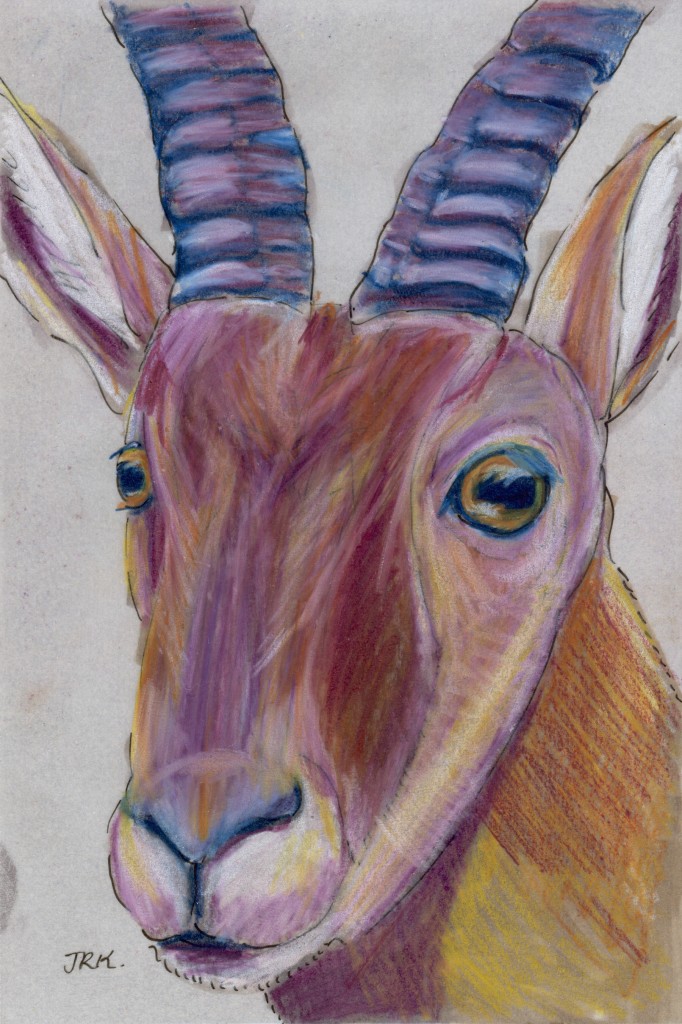
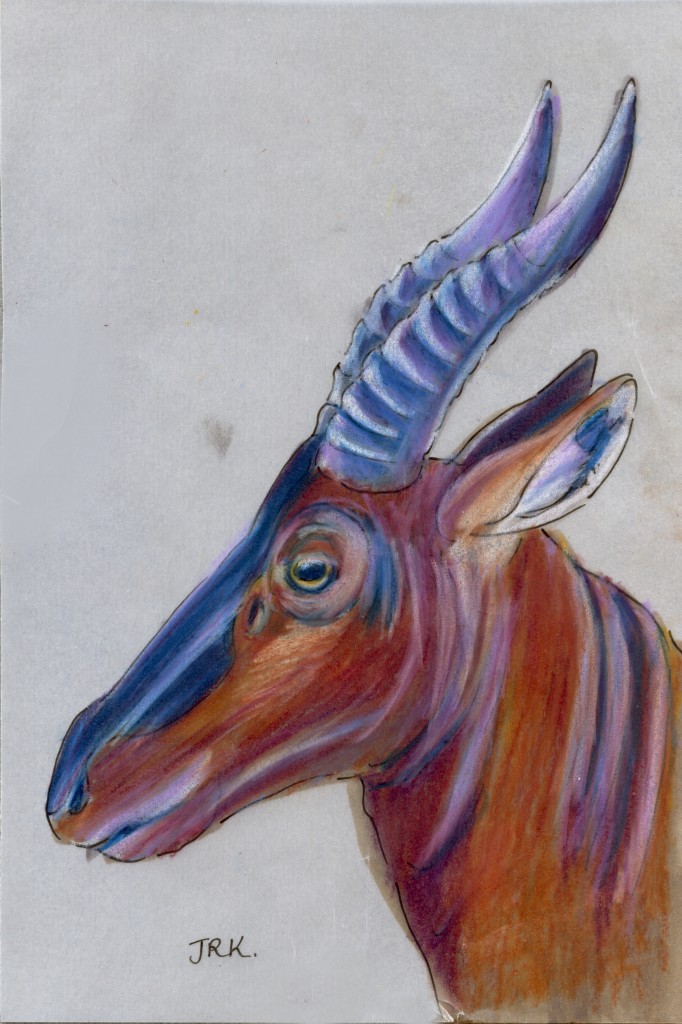
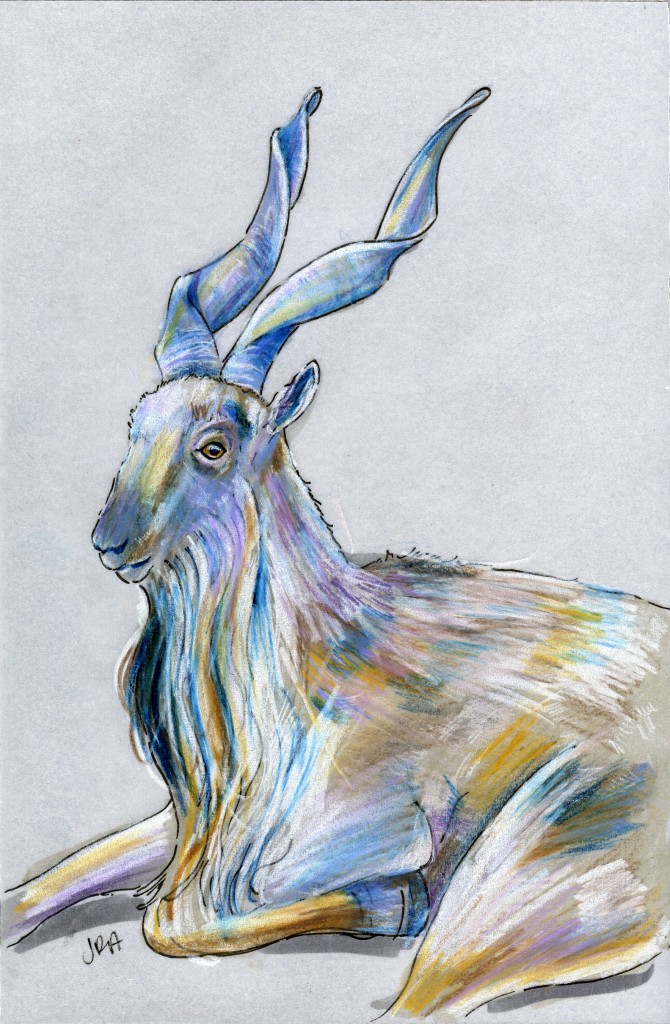
Mrs. Gray's lechwe, Kobus megaceros

Mrs. Gray’s lechwe (click image to enlarge)

0418

Today’s Mammalympian is a fencer. Well, sort of. In human fencing, the object is to touch your opponent with your blade; your opponent uses his or her blade to keep you from doing that, while also trying to touch you. Some mammals carry their “blades” on their heads in the form of horns or antlers, and they’re more likely to attempt to wrestle their opponents to the ground. Maybe it’s more like arm wrestling. But for both humans and other mammals, the ultimate goal is to assert dominance over a rival.

Lechwes are antelopes, and this species spends a lot of time in shallow water. They have extra-long hooves that help them navigate swampy places, and males will apparently spar with their heads underwater. Mrs. Gray’s lechwe lives in Ethiopia and Sudan, and the IUCN lists it as endangered, mostly because of civil war, the displacement and resettlement of humans, and hunting for meat.

portrait of Maria Emma Gray and John Edward Gray from 1863

Mrs. Gray’s lechwe is more commonly called the Nile lechwe, but I’m interested in Mrs. Gray. I spent an hour or two yesterday figuring out exactly who she was, only to discover this morning that my new copy of Mammals: Their Latin Names Explained by A.F. Gotch could have told me. Mrs. Gray was Maria Emma Gray, and her husband, John Edward Gray, was a keeper at the British Museum. He named this species Kobus maria, but someone had already named it Kobus megaceros (megaceros means big horn), and with scientific names, the earlier name sticks. To the left is a portrait of Mrs. and Mr. Gray from 1863. She was 13 years older than him and the widow of his second cousin.

I’ve found a bit of a kindred spirit in Mrs. Gray. Over 15 years or so, she produced a five-volume set of her etchings of molluscs, called Figures of Molluscous Animals, Selected from Various Authors, Etched for the Use of Students. In his preface to her work, Mrs. Gray’s husband writes,

“The tracings from which these Etchings of Molluscous Animals have been taken, were originally made by Mrs. GRAY, for my use, with the view of their being added to my collection of figures of Shells, and to aid me in their arrangement. Hoping that others may find such a collection of figures (many of them copied from expensive works, and brought together from sources not easily accessible to Conchologists in general) as useful as they have been to myself, I induced Mrs. GRAY to make slight etchings of them, which afforded her an interesting occupation when she has been confined to the house by ill health.”

Rather condescending, as I suppose befits a Victorian husband, but Mrs. Gray’s work lives on, and you can look at or download her books at the Biodiversity Heritage Library. Below is a sample from volume three.

etchings of molluscs by Maria Emma Gray

{ 0 comments }

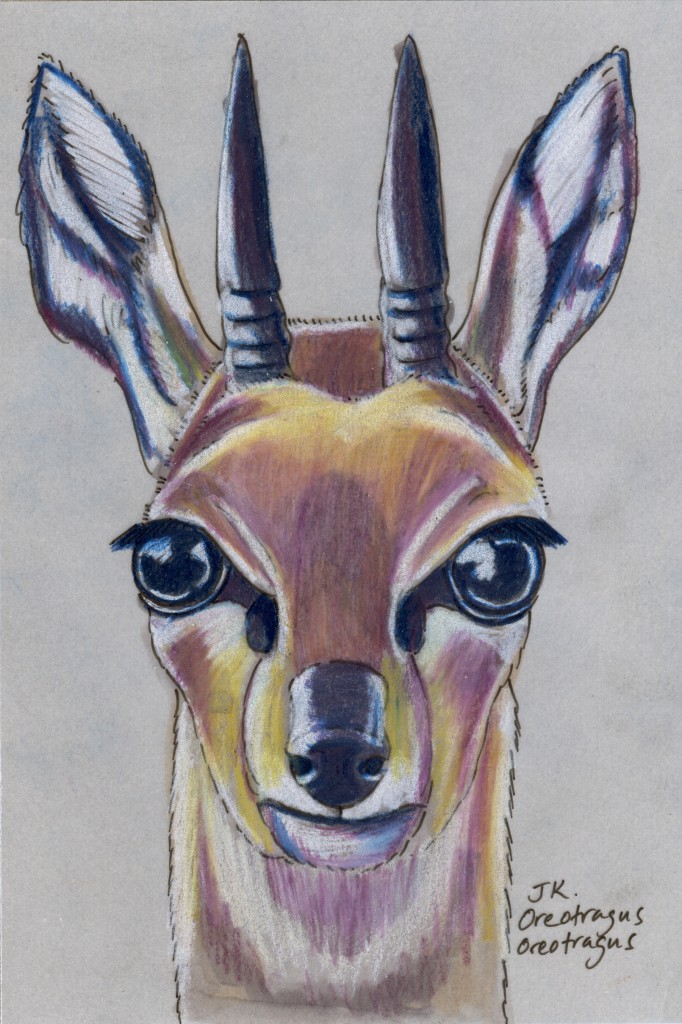
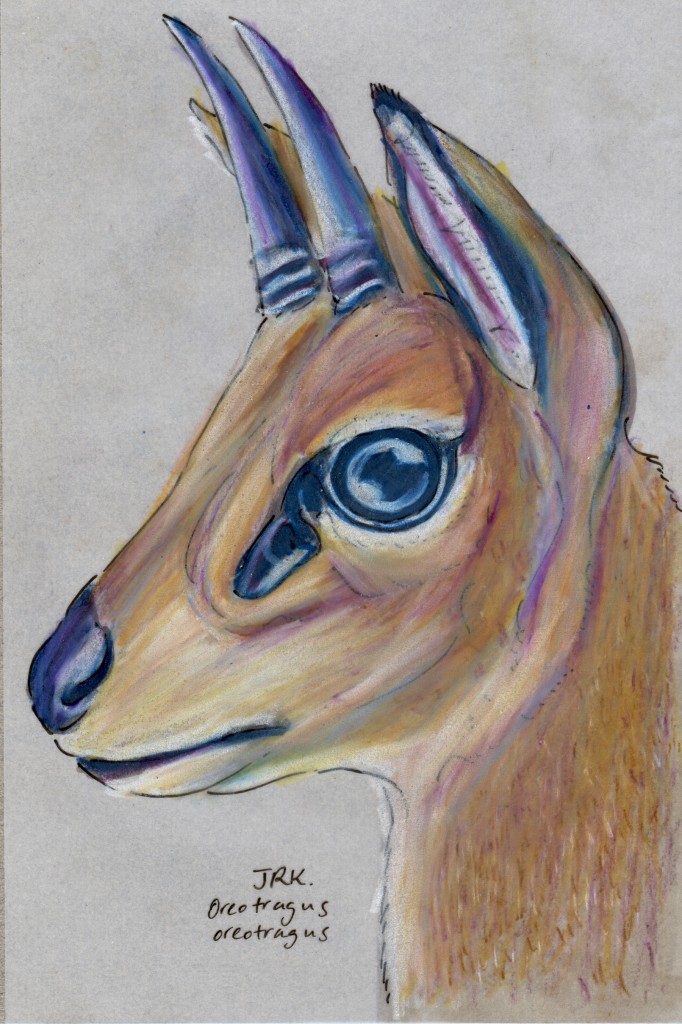
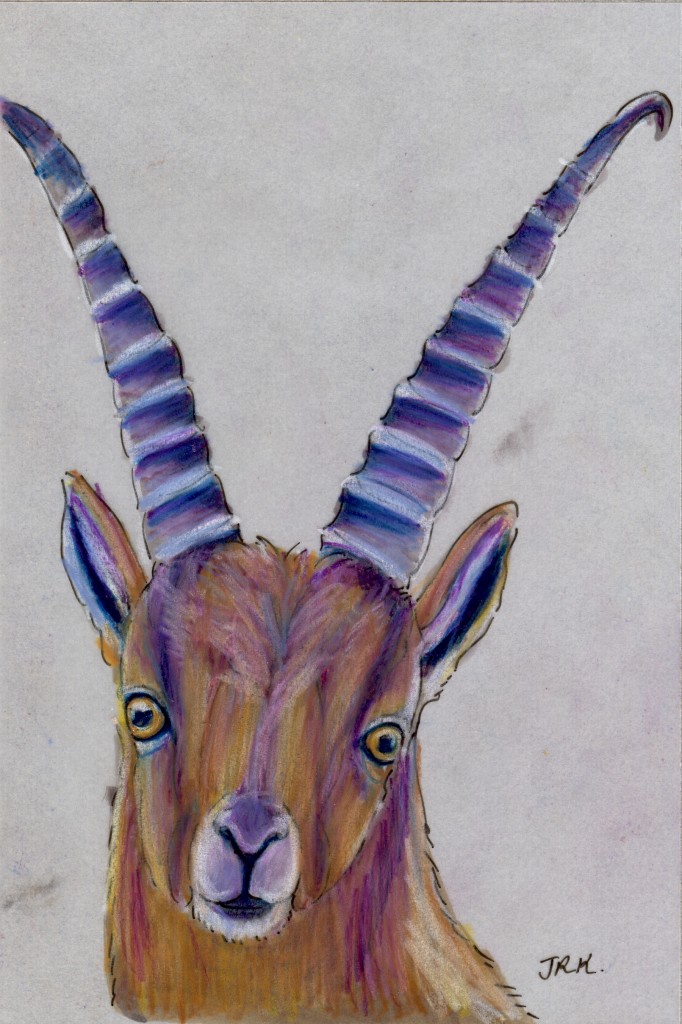
Klipspringer, Oreotragus oreotragus

Klipspringer (click image to enlarge)

The Mammal Olympiad continues! We’re looking at the best athletes in the world, and today’s event is the high jump. The champion is the klipspringer, an African antelope whose name means “rock jumper” in Dutch. Klipspringers can jump 25 feet in the air, and they’re less than two feet tall at the shoulder. The human high jump record, on the other hand, is only eight feet. And there’s no Fosbury flop for klipspringers: they can land on a projecting rock the size of a silver dollar.

The secret is in their hooves. They walk and jump on only the very edges of their tiny hooves, and since hooves are already like toes, it’s kind of like if we were to walk on our toenails. And between the two hooves on each klipspringer foot is a rubbery connection that keeps their toes from splaying and offers some grip on the rocks.

This is the second time I’ve drawn the klipspringer. The first was in March, 2011, as part of Mating Week.

{ 4 comments }

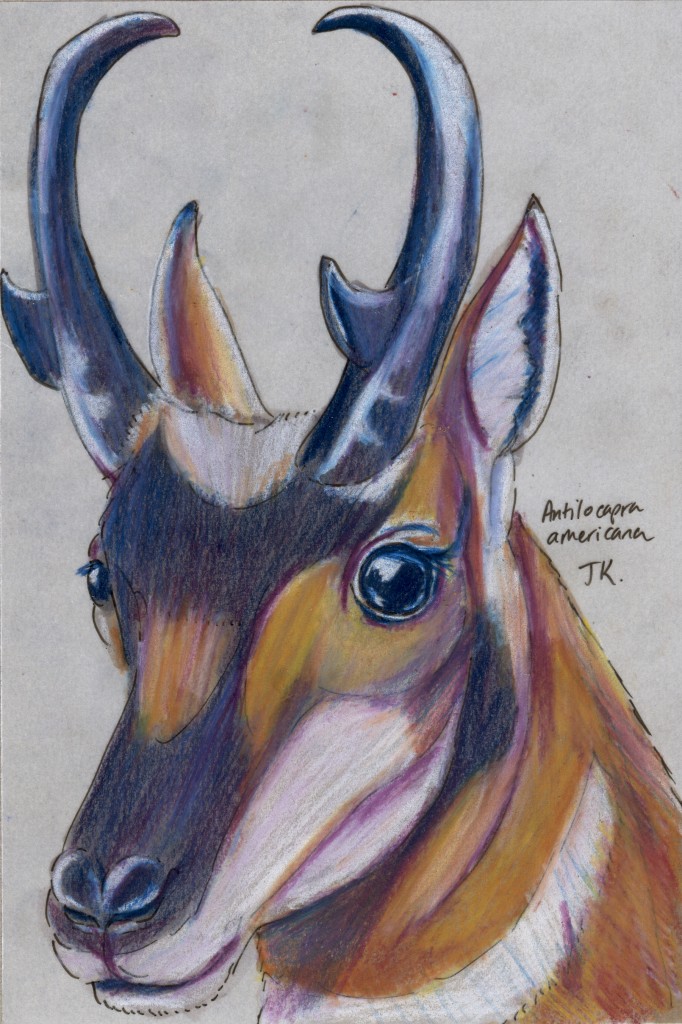
Pronghorn, Antilocapra americana

Pronghorn (click image to enlarge)

The human Olympics start tonight on NBC, and the mammal Olympics start tonight here on the Daily Mammal! We’ll be looking at a few of the best mammalian athletes in the world. The first event is the marathon.

Now, humans are pretty good at marathons. In fact, long-distance running is humans’ best sport. Slate had an article a couple of months ago whose subtitle said it all: “Why nearly every sport except long-distance running is fundamentally absurd.” Other animals beat us easily at swimming, jumping, and sprinting, but we can actually beat most of them at running long distances, thanks to our big butts, springy legs and feet, and maybe especially our prodigious sweating. We probably evolved this amazing ability before we developed all our handy hunting tools so we could run down our dinners. While wolves and other predators usually run maybe 15 miles in a day, humans routinely run not only 26.2-mile marathons but 50- or even 100-mile ultramarathons. (Not all humans, obviously. Maybe there are some out-of-shape wolves out there, too.)

Even though we’re really great at running, we’re still not the marathon champions of the animal kingdom. That honor goes to the pronghorn antelope, who is not really an antelope at all but actually the only surviving species of the Antilocapridae family, and one of my favorite mammals because it lives here in New Mexico and I’ve seen it my whole life. The pronghorn, in fact, is the world’s second-fastest mammal, and would easily beat a cheetah in any race longer than a quarter of a mile, according to this article from Popular Mechanics. The same article estimates the pronghorn’s marathon time at 45 minutes; the fastest human marathoner takes more than two hours.

I drew the pronghorn four years ago, too, and that post is worth reading to hear more about the species’ uniqueness. It has some good comments, too. And as a point of interest, I used the same composition for this new drawing so we can see how my drawing style has changed (improved?) over the years. Here are the two drawings side by side.

An older drawing of a pronghorn next to today's drawing.

Pronghorns from 2008 and 2012 (click image to enlarge)

{ 3 comments }

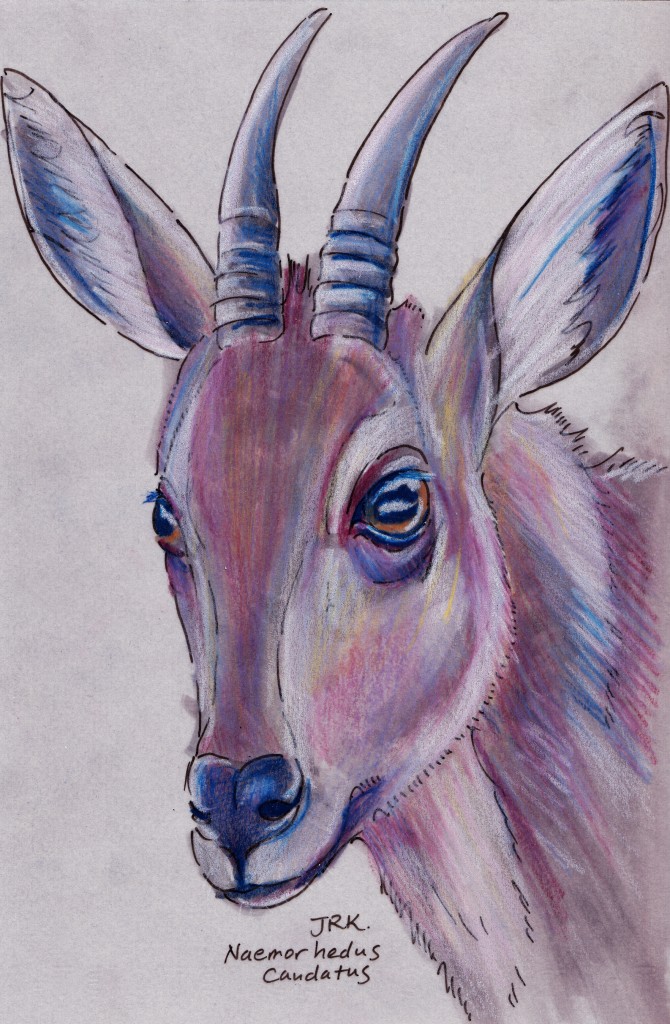
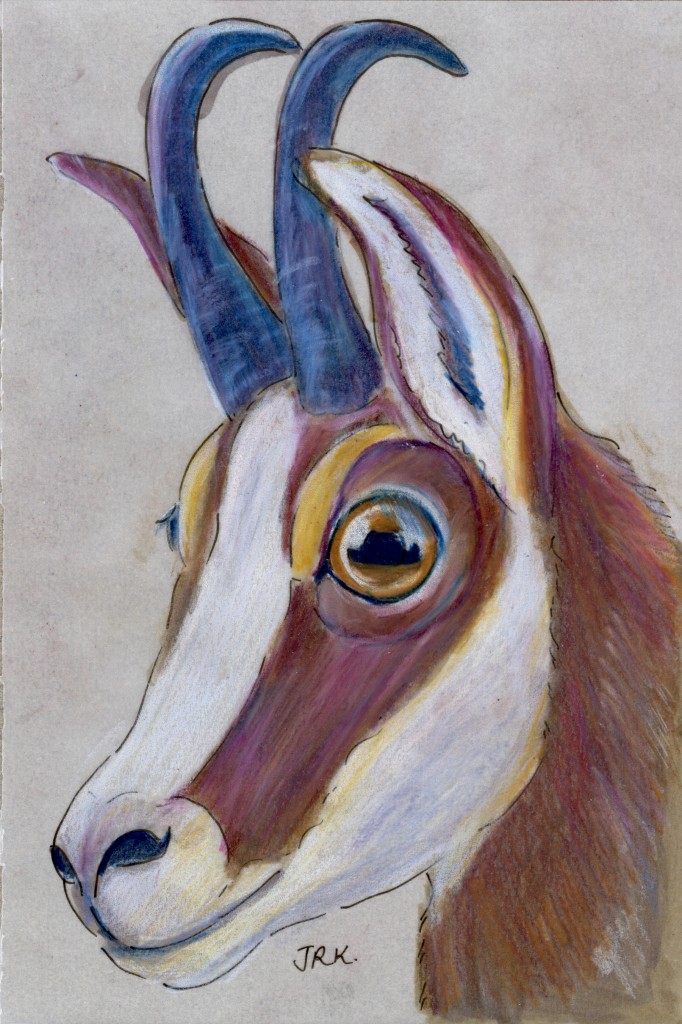
Long-tailed goral (click image to enlarge)


Long-tailed goral by Coco, age 12


0393

Here is a long-tailed goral, another mammal of Primorye, the region in the far east of Russia that we’re visiting this week. If you’d like a brief introduction to the place and why we’re there, check out Monday’s musk deer. The long-tailed goral is a goat that lives in China, Russia, and north and south Korea. It’s rare for a goat to have a long tail, so this goral has something to boast about. There are about 1,300 long-tailed gorals in all the world. Isn’t that remarkable? There are 6 billion of us—just the one species, Homo sapiens—and only 1,300 of this other species. They’re currently classified as vulnerable by the International Union for Conservation of Nature, and they are a natural monument in South Korea.

According to Animal Diversity Web, long-tailed gorals (which are also called Chinese gorals) “communicate with one another in times of emergency with wheezing alarm sounds…During mating season, males attract females with a “zer… zer” or “ze-ze-ze” call. When females approach and are ready to encourage a male, they make a whistling noise.” That is also what I do when I’m ready to encourage a male, coincidentally.

{ 5 comments }

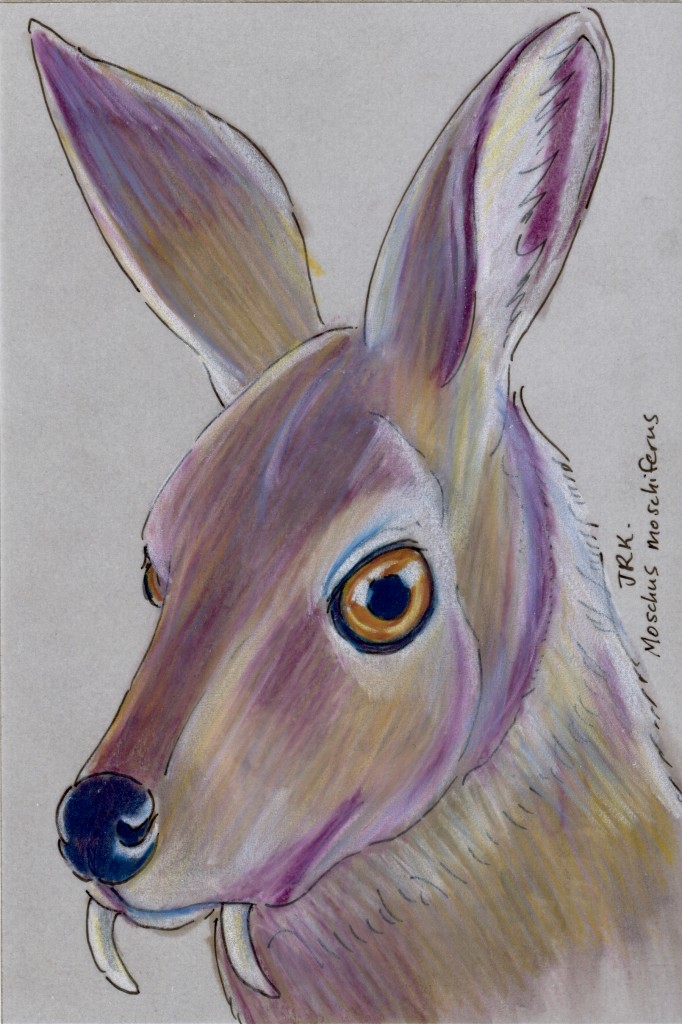
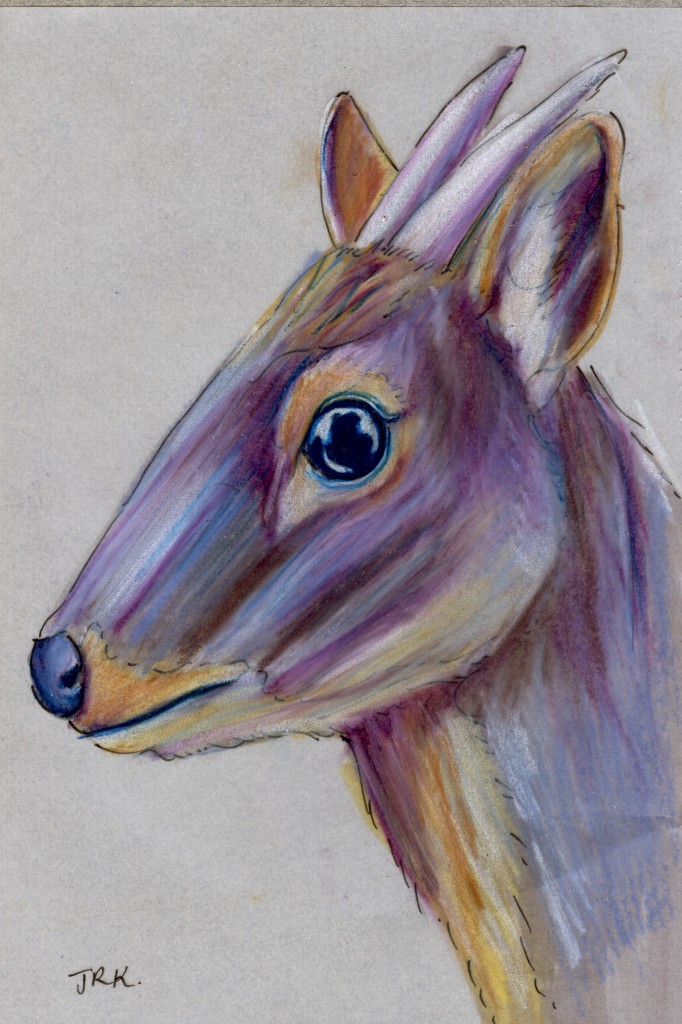
Siberian musk deer (click image to enlarge)


0388

I’m reading a book called The Tiger: A True Story of Vengeance and Survival, by John Vaillant. It’s about Siberian tigers and tiger trackers in the far east of Russia, a region called Primorsky Krai, the Maritime Province, or Primorye. It’s a fascinating place, closer geographically to Beijing and even to Australia than to Moscow, and amazingly biologically diverse. Vaillant says that “Primorye is also the meeting place of four distinct bioregions,” the taiga, the steppes, the subtropics, and the far-northern forest:

“Here, timber wolves and reindeer share terrain with spoonbills and poisonous snakes, and twenty-five-pound Eurasian vultures will compete for carrion with saber-beaked jungle crows. Birch, spruce, oak, and fir can grow in the same valley as wild kiwis, giant lotus, and sixty-foot lilacs, while pine trees bearing edible nuts may be hung with wild grapes and magnolia vines. These, in turn, feed and shelter herds of wild boar and families of musk deer whose four-inch fangs give them the appearance of evolutionary outtakes. Nowhere else can a wolverine, brown bear, or moose drink from the same river as a leopard, in a watershed that also hosts cork trees, bamboo, and solitary yews that predate the Orthodox Church. In the midst of this, Himalayan black bears build haphazard platforms in wild cherry trees that seem to fragile for the task, opium poppies nod in the sun, and ginseng keeps its secret in dappled shade.”

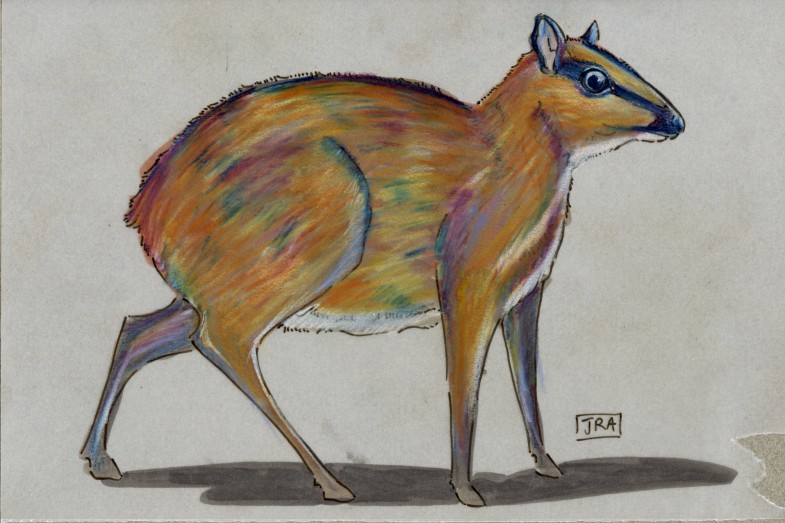
Beautiful, isn’t it? And inspiring to an amateur mammalogist like me. This week, we’ll look at some of the mammals of Primorye, like those mentioned above, beginning with today’s fellow, who isn’t Bunnicula, but rather the Siberian musk deer.

Musk deer, as their name suggests, are the traditional source of the musk that we use in perfume. Musk comes from a gland, or musk-pod, in the male musk deer, and generally, someone who wants that musk-pod will kill the deer for it. The musk deer has been so heavily hunted that it is now internationally protected, but still, poachers poach, and our friend’s numbers are declining.

Here is a link to a video from Arkive of the musk deer in action. It has powerful hind legs and weaker front ones, like a rabbit, and it moves through a series of bounds. I also like the sound of the cold wind in this video.
ARKive video - Siberian musk deer - overview

{ 5 comments }

Today begins our week-long Mammalthon to benefit Japan. As I’m sure you know, Japan was hit by a major earthquake and tsunami earlier this month. Tens of thousands of people have died, and hundreds of thousands have lost their homes. The Daily Mammal would like to do something to help in some small way.

Both of today’s drawings have sold, but all week, Coco and I will be posting drawings of Japanese mammals. You can buy the original drawings and 100 percent of the purchase price will go to benefit victims of the Japanese earthquakes: half to the American Red Cross and half to Animal Refuge Kansai, a Japanese organization that’s rescuing pets who lost their homes in the earthquakes and tsunamis.

You can buy just a drawing—mine are $50 and Coco’s are $25—or get it matted for $10 more. We’ll cover the shipping, and we’ll send them all out at the end of the week. Please note that if you want a matted drawing, you’ll have to wait an extra week or so because while I’ve ordered mats, I don’t have them yet.

Click the “Donate” button at the bottom of this post if you’d just like to donate to our fund without buying a drawing.

Japanese serow (click image to enlarge)

0369

Today’s mammal is the Japanese serow, a goat-antelope that is endemic to the mountains of Japan. It’s particularly widespread on the islands of Honshu and Shikoku. The IUCN says it’s a species of least concern. As I’ve been researching and drawing these wild mammals, I’ve been wondering about how they’ve been affected by the earthquakes. I don’t think anyone’s had the time to find out yet. Here’s Coco’s drawing of the serow:

Japanese serow by Coco, age 12 (click image to enlarge)

Japan designates certain places, minerals, plants, and animals as natural monuments deserving of recognition under the country’s laws that protect cultural properties. There are about 1,000 so designated natural monuments, and 75 of them are further classified as special natural monuments. The Japanese serow was named a special natural monument in the 1950s. At least one of the other species we’ll be meeting this week also has this prestigious designation.

{ 2 comments }

African Buffalo (Syncerus caffer)

by JR Kinyak on March 26, 2011

in Ungulates

There certainly is a fierce beast to meet today, but don’t forget that tomorrow is the beginning of the Japan Mammalthon, and Coco and I will be posting original drawings that you can buy, with all proceeds benefiting victims of the tsunamis and earthquakes. Read this post for all the details.

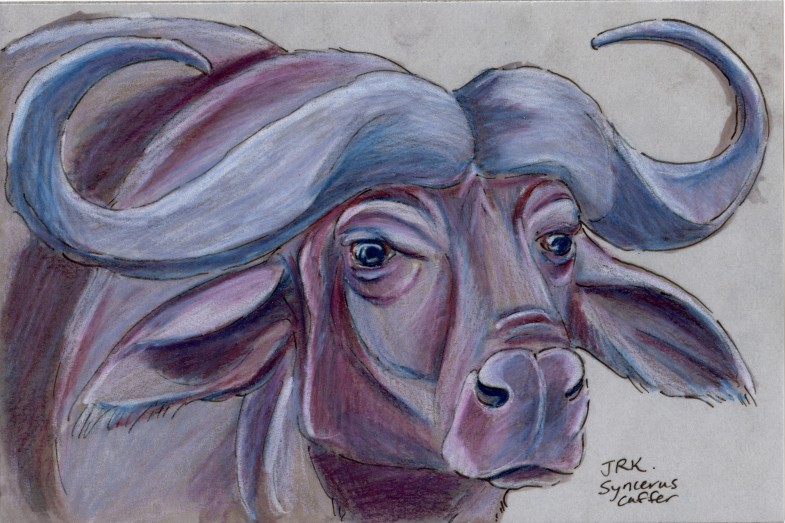
African buffalo (click image to enlarge)

0368

“…[I]t has an unpleasant habit of remaining quietly in its lair until the unsuspecting traveler passes closely to its place of concealment, and then leaping suddenly upon him like some terrible monster of the waters, dripping with mud, and filled with rage. When it has succeeded in its attack, it first tosses the unhappy victim in the air, then kneels upon his body, in order to crush the life out of him, then butts at the dead corpse until it has given vent to its insane fury, and ends by licking the mangled limbs until it strips off the flesh with its rough tongue.”

John George Wood,
The Illustrated Natural History, 1865

The African or Cape buffalo provides a fine case study for anyone interested in the human relationship to other mammals. This buffalo, which lives in southern Africa, is one of the “Big Five” specially prized trophy animals for hunters on safari in Africa. The five animals—the others are the leopard, the lion, the rhinoceros, and the elephant—are considered the most difficult and dangerous to hunt, and no more so, I’m sure, than this behorned fellow.

I searched Google Books for 19th-century accounts by naturalists and self-satisfied hunters and found descriptions including “grim and vicious,” “ever sulky and completely inaccessible to any mollifying influences,” “fierce, treacherous, and savage,” “terrible in outward aspect,” “savage ferocity,” and “fierce and malignant aspect.”

Seasoned hunters of the 1800s advise that “unless you are tired of life,” you should not attempt shooting this beast from the front, for it “fears nothing” and is “one of the few animals which seem to cherish the spirit of revenge.” One writer says that its ugly mug is a good illustration of the principle that “the face is the index of the mind or disposition”; another says that the buffalo’s “little fierce eyes twinkle with sullen rays.” Beware, says one chronicler of the ferocious buffalo, for it “will willingly meet the hunter half-way and try conclusions with him.” Wounded buffalo, in particular, are depicted as ruthless in their bloodthirst, power, and vengefulness. As a vegetarian, I particularly enjoyed this comment:

“It is singular that so much malignity should be found in a beast which subsists only on vegetable food; but such is undoubtedly the case.”

Not only are these buffalo depicted as dangerous, they are universally said to be downright homicidal. I read several references to their insanity and treachery. Interestingly, unlike the similar-looking Asian water buffalo, the African buffalo has never been domesticated, at least not successfully. In interviews—or at least press releases—from a couple of years ago, a scientist who published a study pinpointing genetic “regions” connected with domestication mentioned the African buffalo as a particularly hard case, one that might be helped with some sort of genetic modification.

I do not dispute that African buffalo are incredibly dangerous and responsible for many deaths, but I can’t help but think that some of these anthropomorphized accounts of their ferocity are exaggerated by the pomp and bluster of vainglorious “white hunters” who feel compelled to make their “sport” seem as perilous as possible. Hunters still spout the same lines: safariBwana.com, which calls itself “the African hunting authority,” says that the African buffalo is a “worthy hunting adversary” and “one of the only beasts in the bush that looks at you as if you owe it something.” I tried—not very hard at all—to find video of a buffalo attacking hunters, but I didn’t find much to remark on. Anyway, someone who’s being shot by a powerful rifle with a reinforced bullet—because the buffalo has such thick skin—has a right to be angry, even vengeful, if animals ever do feel such emotions.

{ 0 comments }