From the category archives:

Primates

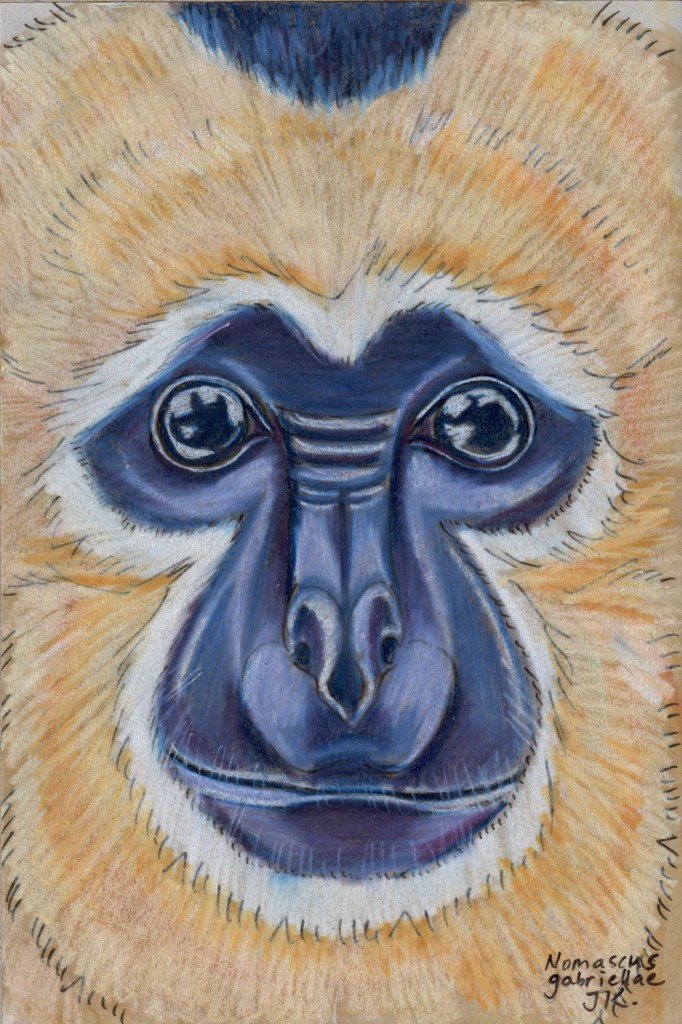
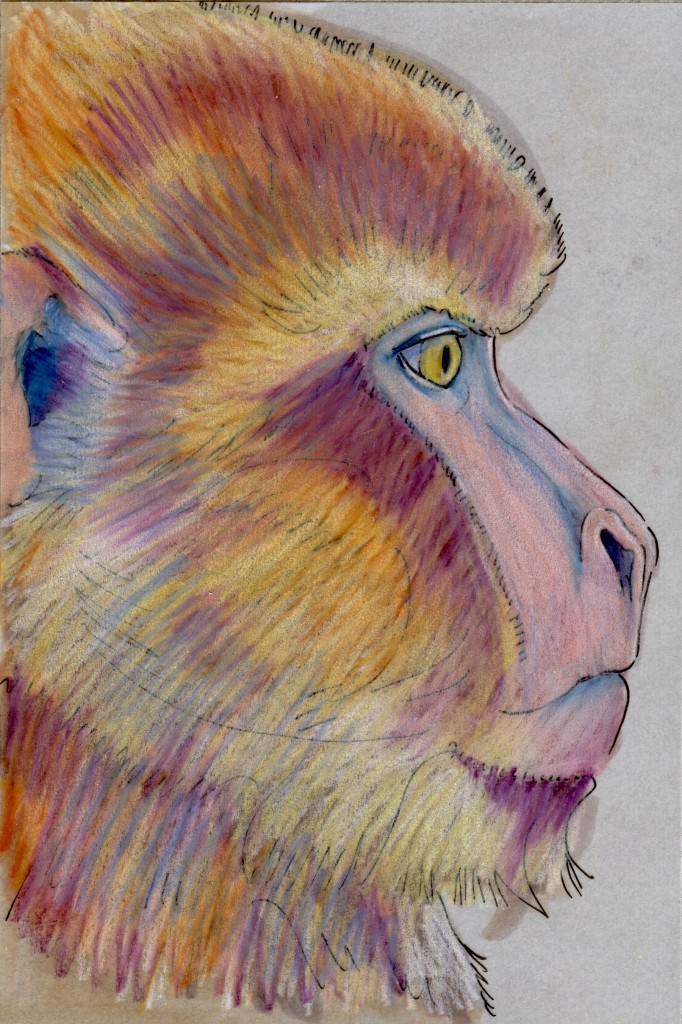
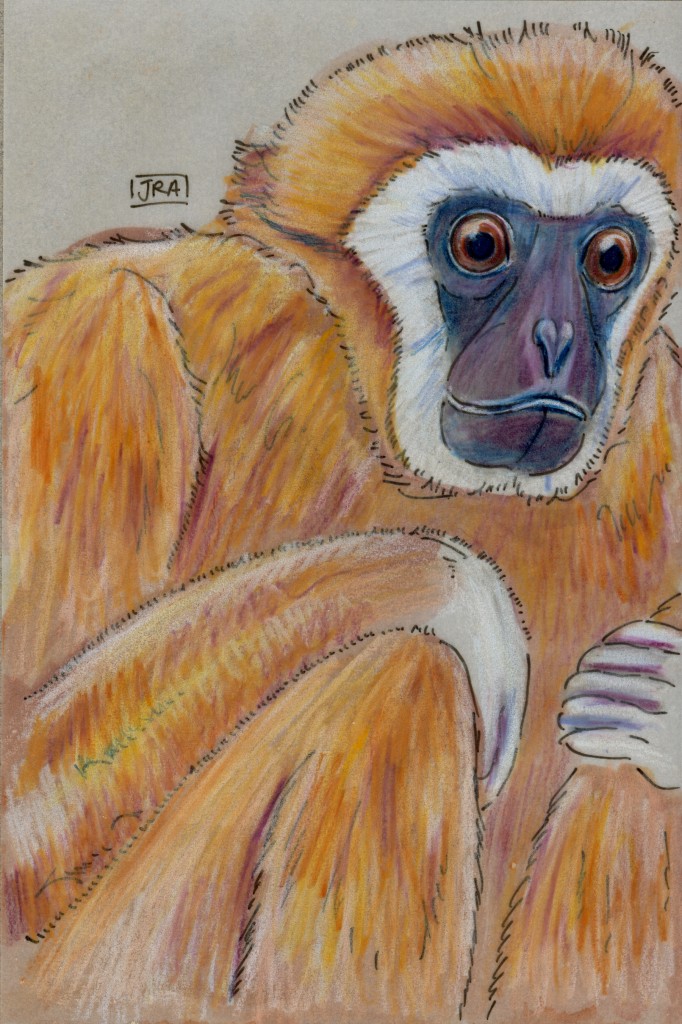
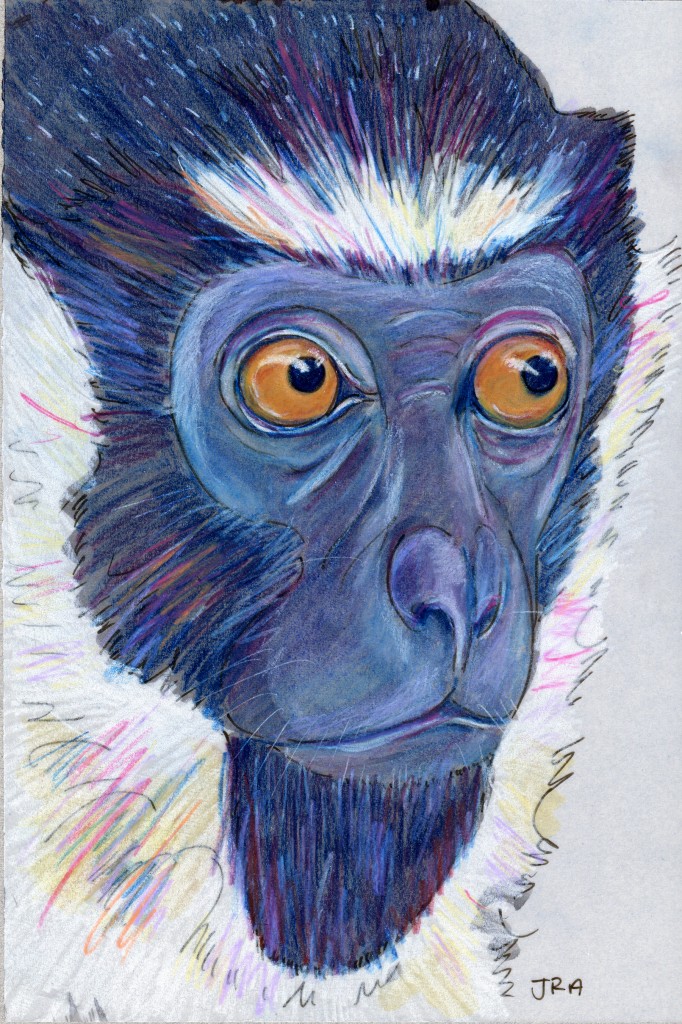
Buff-cheeked gibbon, Nomascus gabriellae

Buff-cheeked gibbon (click image to enlarge)


0416

While the human Olympics continue in London, the Mammal Olympiad continues here on the Daily Mammal! Today, we have a gymnast. As with human gymnastics, mammal gymnastics is difficult to judge in that there’s no fastest, no deepest, no highest. The best gymnast is the one who performs the most skillfully, gracefully, powerfully, and beautifully. In searching for the creature who might be named the best gymnast among mammals, I kept finding videos of gibbons, like this one.

Doesn’t that call to mind a human gymnast on the uneven bars, like this one?

Well, maybe not that one exactly. That was Nadia Comaneci, earning the first perfect 10 in gymnastics. Now they don’t have perfect 10s anymore. Notice that the scoreboard couldn’t even display four digits, so they showed her score as 1.00! Incidentally, Nadia Comaneci is married to Bart Conner, who for some reason lends his gymnastics expertise to this completely stupid segment of Man vs. Beast, in which a human gymnast competes with an orangutan to see who can hang from a bar longer. But the fix is in!

The fix having something to do with the fact that not only did the orangutan not know he was in a competition, but competitions are meaningless to orangutans.

Gibbons, of which there are some sixteen species, are apes: lesser apes, distinguishing them from the great apes, who are the humans, chimpanzees, gorillas, bonobos, and orangutans. They’re supremely good at brachiation, which is traveling through tree branches, thanks to their very long arms and ball-and-socket wrists.

The buff-cheeked gibbon shown above is a female; males have dark faces with buff cheeks. They live in Cambodia, Laos, and Vietnam, and they’re also called yellow-cheeked gibbons or red-cheeked gibbons, but I think buff-cheeked is most accurate. Unfortunately, they’re endangered, thanks to hunting for food and the pet trade.

photo of Gabrielle Vassal with native French Congolese women

The gabriellae part of the buff-cheeked gibbon’s scientific name is in honor of Gabrielle M. Vassal. Vassal was married to a French military doctor, and in the early 20th century, she went with him to his posts and wrote travel books, including In and Round Yunnan Fou, On and Off Duty in Annam, and Life in French Congo. Madame Vassal was a skilled hunter and a naturalist and she contributed specimens to several natural history museums. To the right is a photo of her from Life in French Congo. (She, of course, is the colonialist in the picture.)

Here’s a sample of the amazing songs that buff-cheeked gibbon pairs sing. These two are in a zoo, and their infant children whistle a little in the song, too.

{ 7 comments }

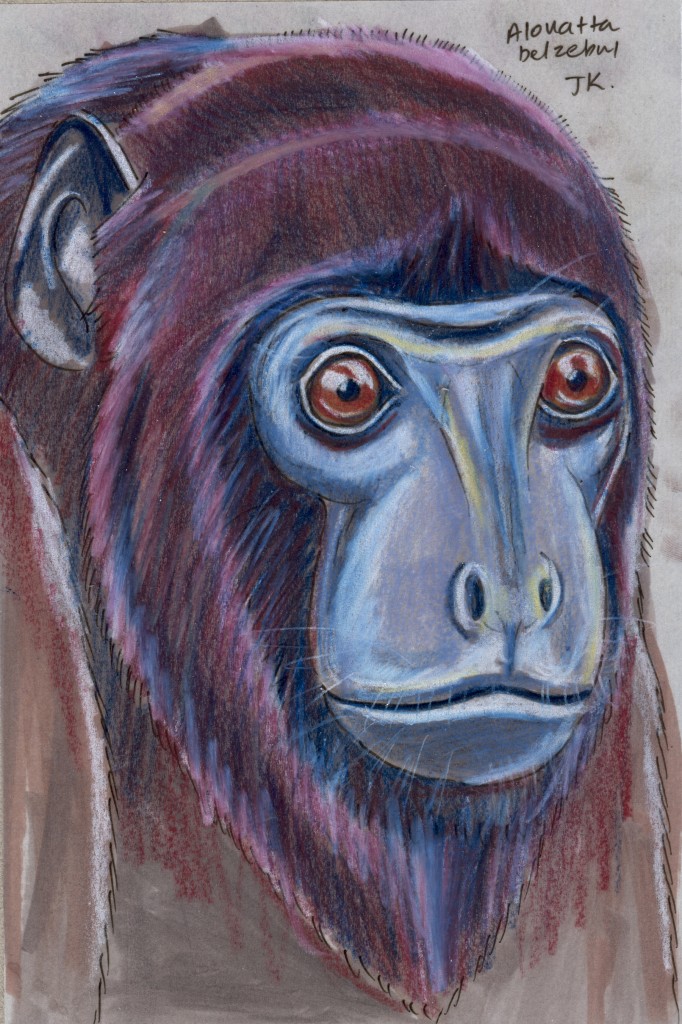
Red-handed howler monkey, Alouatta belzebul

Red-handed howler monkey (click image to enlarge)


0414

Here’s our last randomly picked mammal for now: tomorrow the Mammal Olympiad starts! Let’s let this red-handed howler monkey see us out of Random Week. The red-handed howler lives in Brazil. Among howler monkeys, it isn’t very well studied, by which I mean that humans haven’t studied it very well, not that it isn’t learned or educated. It eats leaves (because it’s folivorous!), and it has a few traits that I think would come in handy: a prehensile tail, a schizodactylous grip (which means that it has two digits opposing the other three, unlike our hands, which have just the opposable thumb), and what the IUCN’s description characterizes as an “enlarged and highly specialized voice box” for letting loose howls and grunts. Animal Diversity Web says, “Red-handed howler monkeys males often howl, allowing them to assess their opponents, a cheap alternative to a physical fight or chase.”

The IUCN lists the red-handed howler monkeys as vulnerable: their population has been declining because of hunting and habitat loss. The habitat loss is a result of agriculture and logging. Here’s another interesting quote from the Animal Diversity Web account of the red-handed howler monkey:

“In 1999 at the Twenty-Second Annual Meeting of the American Society of Primatologists, Loretta Ann Cormier discussed her work on red-handed howler monkeys. She found that they are significant to the diet, religion, and social structure of indigenous peoples. Red-handed howler monkeys and 6 other species of primates found in Amazonian Brazil are primarily eaten during the wet season. The Guajá believe all monkeys are kin, and they always take in infants of mothers that were killed for food and treat them as their children. Some people feel there is a contradiction between family and food, but the religion of the Guajá people portrays this symbolic cannibalism as a religious way of life.”

{ 7 comments }

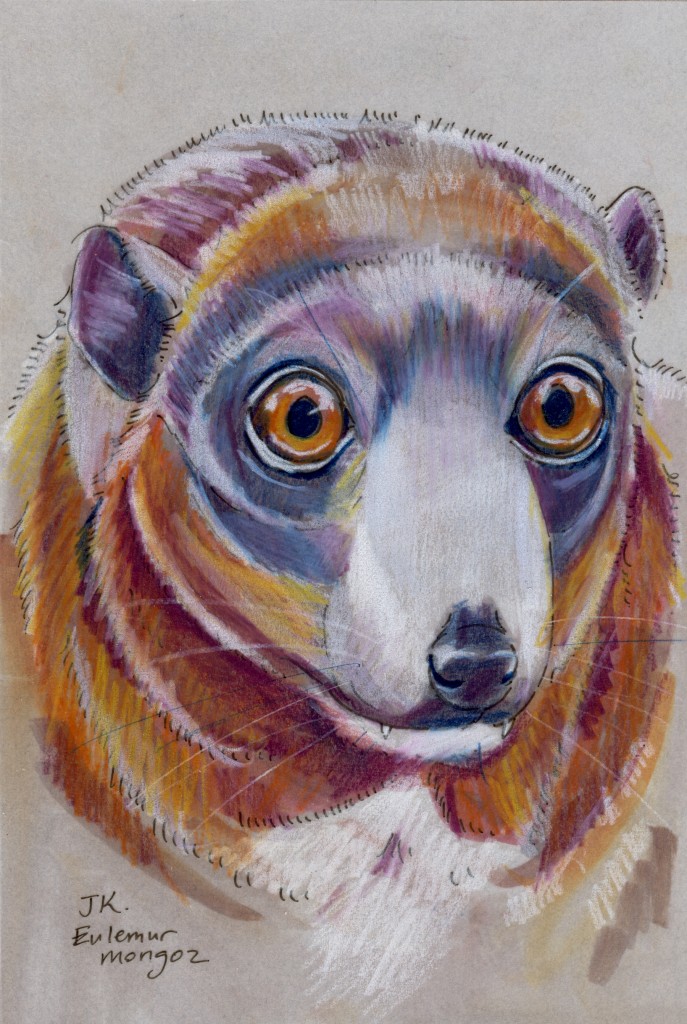
mongoose lemur, Eulemur mongoz

Mongoose lemur (click image to enlarge)


0411

This week, random.org is picking our mammals, and the random-number generator made me very happy this morning. Instead of the statistically likely rodent, we get a lemur! Hello, mongoose lemur. We can tell that this one is a male because his cheeks and beard are red; females are plain gray and white. The mongoose lemur is a little unusual among lemurs for two reasons. Unlike most lemurs, which are either nocturnal or diurnal, the mongoose lemur seems to switch between the two depending on the season. It’s sometimes active at night and sometimes during the day. And while the mongoose lemur does live on Madagascar, like all other lemurs, it is one of only two species that also live on the Comoros Islands, which are about 200 miles northwest of Comoros. On Madgascar, lemurs play a surprising role: they pollinate plants.

{ 6 comments }

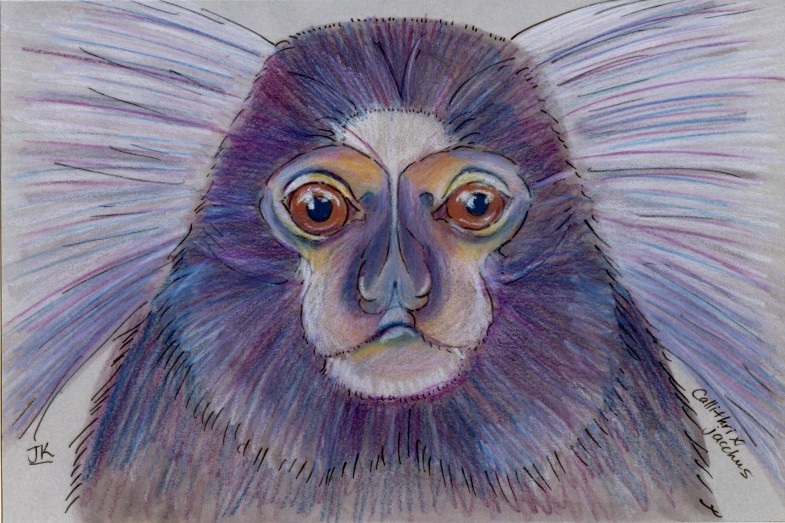
Common Marmoset (Callithrix jacchus)

by JR Kinyak on September 18, 2011

in Primates

Common marmoset (click image to enlarge)

Common marmoset by Coco, age 12

0384

Like many people, some of us Kinyaks are addicted to Angry Birds. The last edition we played, Angry Birds Rio, is a tie-in with the animated movie Rio, which I haven’t seen and don’t plan to, but I assume the characters in the game come from the movie. While the original Angry Birds game has pigs as the birds’ enemies, in Rio, your enemies are marmosets, and after flinging little birds at them, I decided to draw one.

The common marmoset is also known as the white-tufted-ear marmoset. It’s endemic to the forests of eastern Brazil. I’ve just learned a new biology word, and you probably know that learning new biology words is one of my favorite parts of the Daily Mammal. The common marmoset is both an exudativore and an insectivore. That second one is obvious (it eats bugs). The first was new to me. Exudativores make tree sap, resin, and gums a major part of their diet. Common marmosets gnaw into the bark of a tree and then scoop out the sap or what have you with their teeth. About 70 percent of their food-finding time is spent on tree saps and the rest on insects.

{ 4 comments }

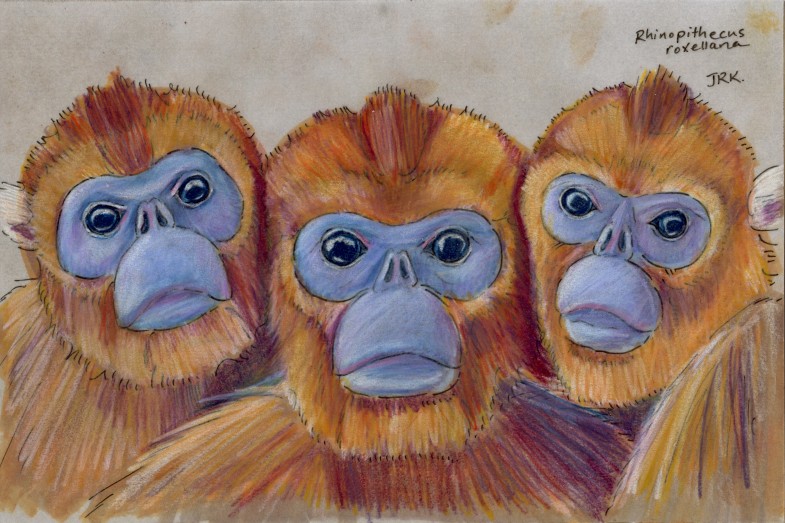
Golden snub-nosed monkeys (click image to enlarge)


0381

Golden snub-nosed monkeys live in central China, with the majority making their homes in the Sichuan province. They roam through mountain forests where snow covers the ground for half the year, eating lichens and other ploants and the occasional insect. They are endangered, and the IUCN tells us that the major threats to their continued existence are habitat loss and tourism-related activities.

I learned from the Eponym Dictionary of Mammals (I need a copy of that book!) that the roxellana part of the monkey’s scientific name comes from Roxelana, a Ukrainian woman who was captured and sold into slavery in the 1500s. She was put in the harem of the sultan Suleyman the Magnificent, where she became his favorite concubine and eventually his second wife. In his poetry, he called her his one and only love. Apparently, she had beautiful golden hair and a turned-up nose, just like these monkeys. But she probably didn’t have a blue face.

{ 4 comments }

This week’s drawings, by me and by Coco, are for sale to benefit animals and people affected by the earthquake and tsunami in Japan! If you buy a drawing, we’ll give half of the purchase price to the American Red Cross and half to Animal Refuge Kansai, an animal shelter in Japan. You can select a matted drawing or leave it unmatted. Unmatted, they’re 6″x9″ in colored pencil and marker on vellum. The mats are 9″x12″ and black. On to today’s monkey!

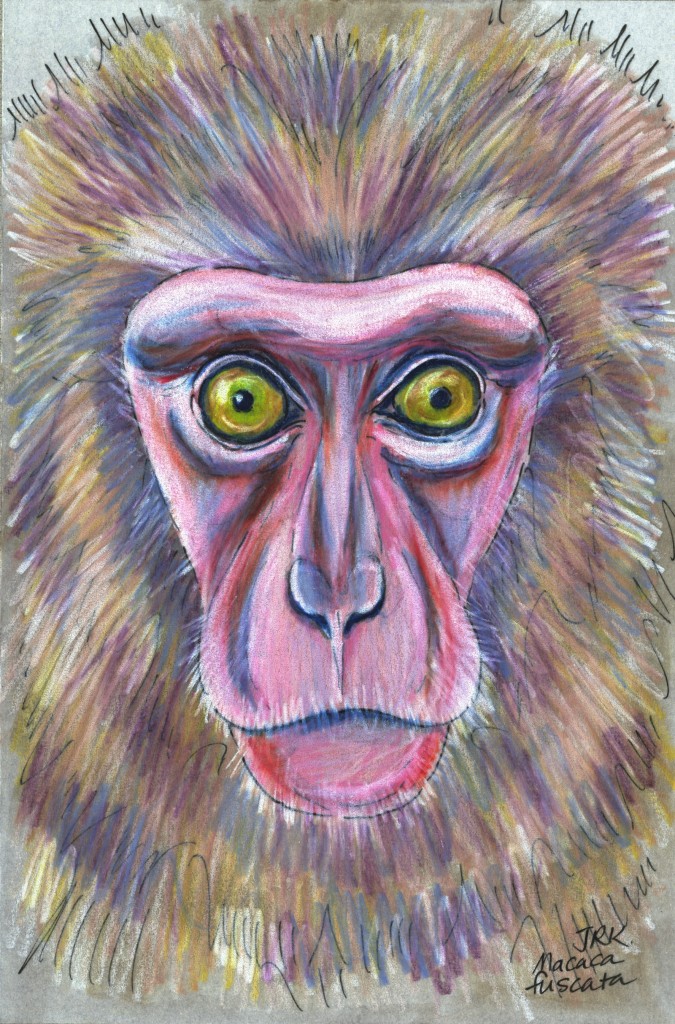
Japanese macaque (click image to enlarge)


0372

This drawing has sold!

The Japanese macaque is also called the snow monkey. They’re the guys you see relaxing in hot tubs and hot springs like this:

(That photo, as you no doubt noticed, is from National Geographic.) I wish there were Japanese macaques at Ten Thousand Waves, our local Japanese-style spa. It would be the perfect addition for the transporting atmosphere. Except I can imagine that they’re pretty noisy, and that might not be relaxing. Here’s a pretty fascinating article about why the macaques started hanging out in hot tubs, along with why they started playing with rocks and washing their sweet potatoes and wheat. The big trendsetter there was an 18-month-old baby girl monkey!

Here is Coco’s Japanese macaque. You should consider buying it to help Japan: all her other drawings have sold out. Collectors are lining up, people.

Japanese macaque by Coco, age 12 (click image to enlarge)

Coco’s drawing has sold!

My Japanese squirrel is still available for sale, too, and if you’re not big on art but you’d like to help the American Red Cross and Animal Refuge Kansai, consider clicking the button below. We’ll put your contribution into our fund.

{ 0 comments }

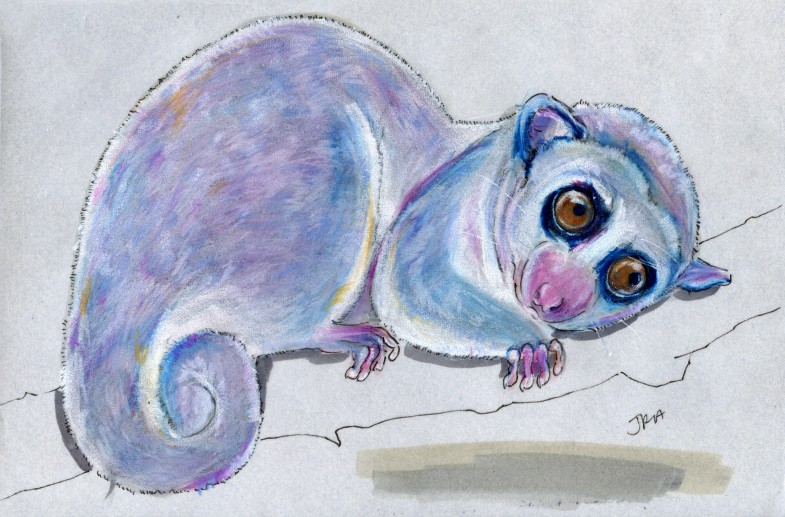
Horsfield’s Tarsier (Tarsius bancanus)

by JR Kinyak on March 10, 2011

in Primates

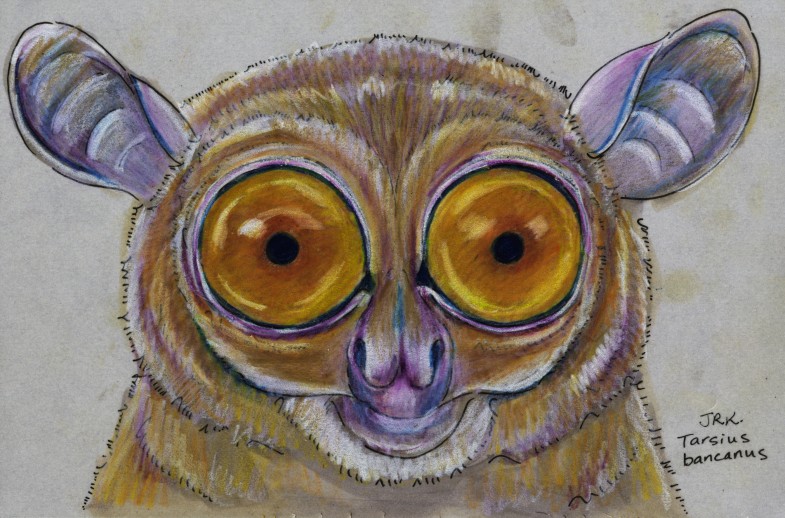
Horsfield's tarsier (click image to enlarge)


0360

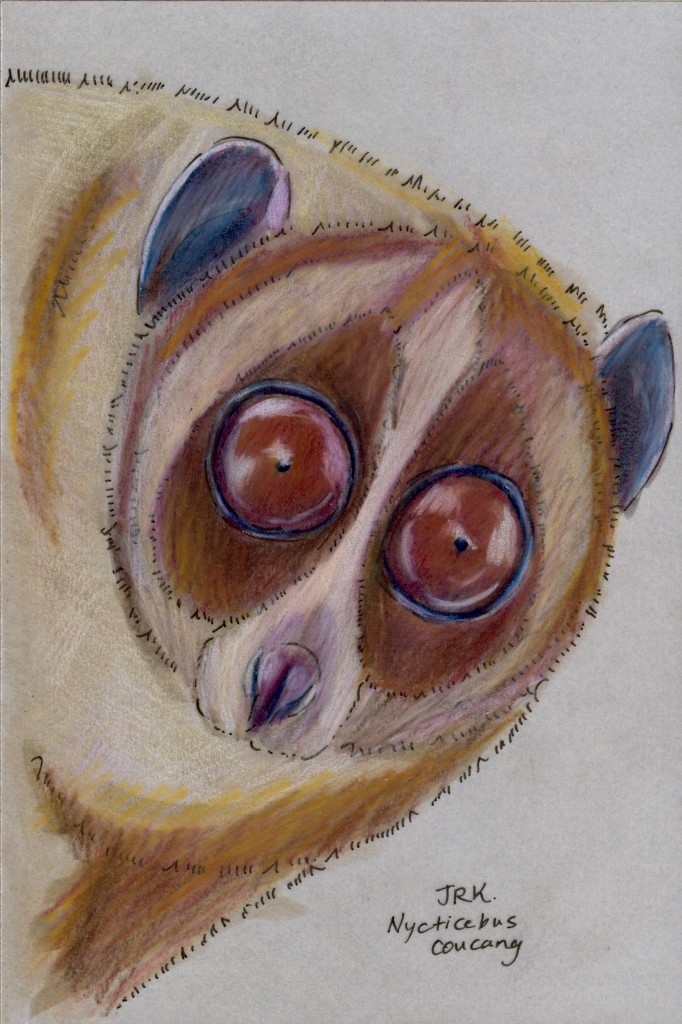
I know we just met the greater slow loris the other day, but here is another fuzzy fellow with huge, unmoving eyes and a neck that swivels 180 degrees. Horsfield’s tarsier lives in Brunei, Indonesia, and Malaysia, where he climbs in the trees and forages on the ground, looking for insects like cicadas, moths, stick bugs, and cockroaches, as well as bats, snakes, and birds to eat. Over the past 20 years, the Horsfield’s tarsier has lost at least 30 percent of its habitat, according to the IUCN, and it’s also a victim of the illegal pet trade.

The name tarsier comes from the tarsus bone, which is in the foot. Tarsiers have elongated ones, which helps them climb.

{ 2 comments }