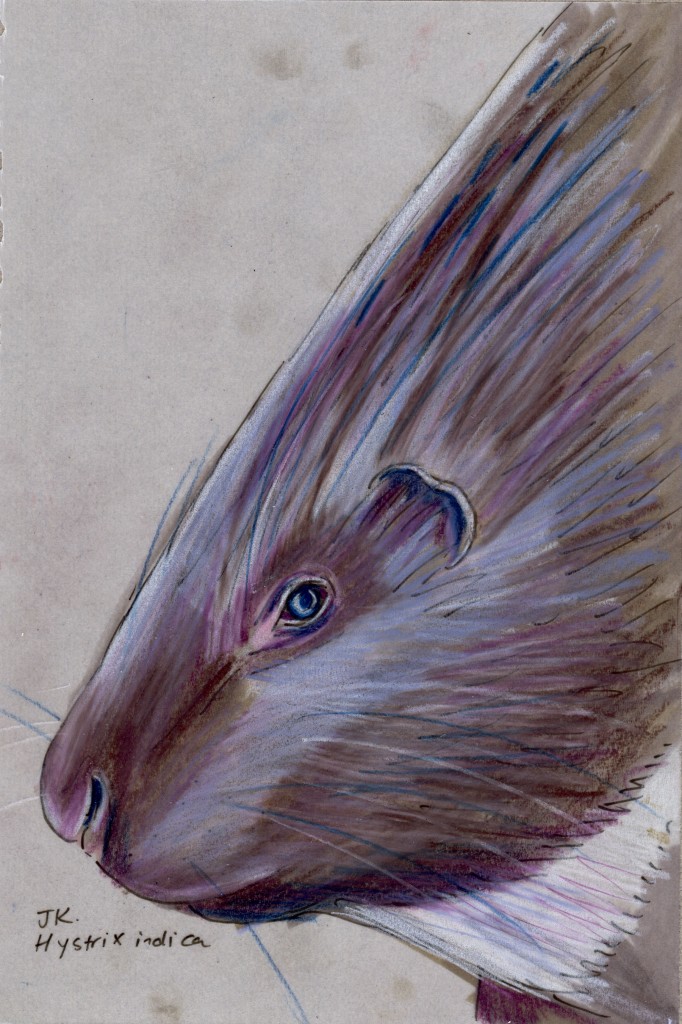
Indian crested porcupine, Hystrix indica

Indian crested porcupine (click image to enlarge)


0419

Before our brief Olympic interlude, I was enjoying letting random.org pick the mammals, so let’s get back to that with another random week. Today, the Indian crested porcupine’s number is up. It’s a nocturnal rodent that lives in the region of Asia and the Middle East bordered on one end by Turkey and Syria and on the other by Kyrgyzstan and India.

Porcupine quills are pretty much hardened hair, and they are attached to muscles that give the porcupine impressive control over the quills. Crested porcupines, like this one, have hollow quills on their tails that they can rattle to ward off predators. Even so, they still get into tangles, and surprisingly, porcupines have been indirectly responsible for the deaths of thousands of humans through their quills. It seems that most of the man-eating tigers and leopards of legend became man-eaters after being injured, such as by having porcupine quills embedded in their bodies. When I first read that, I thought that maybe the pain made them grumpy enough to kill anyone who crossed them, but it turns out that it slows them down enough that they can’t hunt their normal prey and have to start killing slow-moving humans.

Two of the most famous hunters of man-eating cats in India, Jim Corbett and Kenneth Anderson, wrote about the phenomenon of finding porcupine quills in the man-eaters’ dead bodies. Here’s Jim Corbett, in his 1944 book Man-eaters of Kumaon, writing about the man-eater of Mohan, a tiger that he killed in 1930:

“When the skin had been removed from the rest of the animal, I made a long cut from the chest to the pad of the festering left leg, and as I removed the skin, drew out of the flesh, one after another, porcupine quills which the men standing round eagerly seized as souvenirs; the longest of these quills was about five inches, and their total number was between twenty-five and thirty. The flesh under the skin, from the tiger’s chest to the pad of his foot, was soapy, and of a dark yellow colour; cause enough to have made the poor beast moan when he walked, and quite sufficient reason for his having become—and having remained—a man-eater, for porcupine quills do not dissolve no matter how long they are embedded in flesh.

“I have extracted, possibly, a couple of hundred porcupine quills from the man-eating tigers I have shot. Many of these quills have been over nine inches in length and as thick as pencils. The majority were embedded in hard muscles, a few were wedged firmly between bones, and all were broken off short under the skin.”

A few pages earlier in the book, and unrelated to porcupines, Corbett agonizes about having killed this tiger while it slept:

“My personal feelings in the matter are I know of little interest to others, but it occurs to me that possibly you also might think it was not cricket, and in that case I should like to put the arguments before you that I used on myself, in the hope that you will find them more satisfactory than I did. These arguments were (a) the tiger was a man-eater that was better dead than alive, (b) therefore it made no difference whether he was awake or asleep when killed, and (c) that had I walked away when I saw his belly heaving up and down I should have been morally responsible for the deaths of all the human beings he killed thereafter. All good and sound arguments, you will admit, for my having acted as I did; but the regret remains that through fear of the consequences to myself, or fear of losing the only chance I might ever get, or possibly a combination of the two, I did not awaken the sleeping animal and give him a sporting chance.”

Now you can “walk in Jim Corbett’s footsteps” on a guided trek along “the Maneater of Mohan Trail,” hosted by Wild World India; that’s a trip I wouldn’t mind taking.

In case you are as drawn to these characters as I am, here’s Kenneth Anderson, in his 1955 book Nine Man-eaters and One Rogue, telling the story of how he came to kill the Spotted Devil of Gummalapur, a man-eating leopard that was found, after its death, to have porcupine quills embedded in its foot.

Natural History magazine published an article in 2006 that’s pretty interesting on the subject of the force it takes to remove porcupine needles once they’re embedded, as well as on the chemistry of the odor that porcupines emit to warn potential enemies to stay away. And finally, here’s a short night-vision video of an Indian crested porcupine minding its own business.

{ 0 comments }

Mrs. Gray's lechwe, Kobus megaceros

Mrs. Gray’s lechwe (click image to enlarge)

0418

Today’s Mammalympian is a fencer. Well, sort of. In human fencing, the object is to touch your opponent with your blade; your opponent uses his or her blade to keep you from doing that, while also trying to touch you. Some mammals carry their “blades” on their heads in the form of horns or antlers, and they’re more likely to attempt to wrestle their opponents to the ground. Maybe it’s more like arm wrestling. But for both humans and other mammals, the ultimate goal is to assert dominance over a rival.

Lechwes are antelopes, and this species spends a lot of time in shallow water. They have extra-long hooves that help them navigate swampy places, and males will apparently spar with their heads underwater. Mrs. Gray’s lechwe lives in Ethiopia and Sudan, and the IUCN lists it as endangered, mostly because of civil war, the displacement and resettlement of humans, and hunting for meat.

portrait of Maria Emma Gray and John Edward Gray from 1863

Mrs. Gray’s lechwe is more commonly called the Nile lechwe, but I’m interested in Mrs. Gray. I spent an hour or two yesterday figuring out exactly who she was, only to discover this morning that my new copy of Mammals: Their Latin Names Explained by A.F. Gotch could have told me. Mrs. Gray was Maria Emma Gray, and her husband, John Edward Gray, was a keeper at the British Museum. He named this species Kobus maria, but someone had already named it Kobus megaceros (megaceros means big horn), and with scientific names, the earlier name sticks. To the left is a portrait of Mrs. and Mr. Gray from 1863. She was 13 years older than him and the widow of his second cousin.

I’ve found a bit of a kindred spirit in Mrs. Gray. Over 15 years or so, she produced a five-volume set of her etchings of molluscs, called Figures of Molluscous Animals, Selected from Various Authors, Etched for the Use of Students. In his preface to her work, Mrs. Gray’s husband writes,

“The tracings from which these Etchings of Molluscous Animals have been taken, were originally made by Mrs. GRAY, for my use, with the view of their being added to my collection of figures of Shells, and to aid me in their arrangement. Hoping that others may find such a collection of figures (many of them copied from expensive works, and brought together from sources not easily accessible to Conchologists in general) as useful as they have been to myself, I induced Mrs. GRAY to make slight etchings of them, which afforded her an interesting occupation when she has been confined to the house by ill health.”

Rather condescending, as I suppose befits a Victorian husband, but Mrs. Gray’s work lives on, and you can look at or download her books at the Biodiversity Heritage Library. Below is a sample from volume three.

etchings of molluscs by Maria Emma Gray

{ 0 comments }

Merriam's kangaroo rat, Dipodomys merriami

Merriam’s kangaroo rat (click image to enlarge)


0417

As the humans compete in the London Olympics, the other mammals have an Olympiad of their own here at the Daily Mammal! Today’s mammalympian is an amazing long jumper, Merriam’s kangaroo rat, which lives throughout the southwestern United States and in Mexico. It’s nocturnal and solitary and eats mostly seeds, including the seeds of creosote, mesquite, and ocotillo.

This little rodent bounces along on its huge hind legs, using its long tail for balance. It’s basically cantilevered over its back feet. It routinely jumps as far as six feet, which may not sound like much, but remember, the little rat’s body is less than five inches long (the tail adds another five or so). That kind of leap is the equivalent of Mike Powell, the world-record human long jumper, jumping 99 feet instead of 29. Maybe he could jump that far if he had evolved a stupendous leaping ability to help him escape from predators such as owls, rattlesnakes, and coyotes.

Mike Powell set his world record in an astonishing long-jump duel with Carl Lewis at the 1991 World Championships in Tokyo. Carl Lewis hadn’t been beaten at the long jump in a decade, having won 65 straight meets. Bob Beamon’s long jump world record, which was almost two feet longer than the previous one, had stood for almost 23 years. Then in one night, Carl Lewis and Mike Powell both jumped farther than Beamon had. Lewis, however, had a little too much wind at his back, and so his jump didn’t count toward the record. Even if it had, he wouldn’t have held the record very long because Powell jumped even farther than Lewis in the very next round, and the wind had changed. Here’s the TV coverage of their extraordinary showdown. Start at 12:28 to see the two record-breaking jumps, or watch the whole thing if you want—it’s incredible.

{ 0 comments }

Buff-cheeked gibbon, Nomascus gabriellae

Buff-cheeked gibbon (click image to enlarge)


0416

While the human Olympics continue in London, the Mammal Olympiad continues here on the Daily Mammal! Today, we have a gymnast. As with human gymnastics, mammal gymnastics is difficult to judge in that there’s no fastest, no deepest, no highest. The best gymnast is the one who performs the most skillfully, gracefully, powerfully, and beautifully. In searching for the creature who might be named the best gymnast among mammals, I kept finding videos of gibbons, like this one.

Doesn’t that call to mind a human gymnast on the uneven bars, like this one?

Well, maybe not that one exactly. That was Nadia Comaneci, earning the first perfect 10 in gymnastics. Now they don’t have perfect 10s anymore. Notice that the scoreboard couldn’t even display four digits, so they showed her score as 1.00! Incidentally, Nadia Comaneci is married to Bart Conner, who for some reason lends his gymnastics expertise to this completely stupid segment of Man vs. Beast, in which a human gymnast competes with an orangutan to see who can hang from a bar longer. But the fix is in!

The fix having something to do with the fact that not only did the orangutan not know he was in a competition, but competitions are meaningless to orangutans.

Gibbons, of which there are some sixteen species, are apes: lesser apes, distinguishing them from the great apes, who are the humans, chimpanzees, gorillas, bonobos, and orangutans. They’re supremely good at brachiation, which is traveling through tree branches, thanks to their very long arms and ball-and-socket wrists.

The buff-cheeked gibbon shown above is a female; males have dark faces with buff cheeks. They live in Cambodia, Laos, and Vietnam, and they’re also called yellow-cheeked gibbons or red-cheeked gibbons, but I think buff-cheeked is most accurate. Unfortunately, they’re endangered, thanks to hunting for food and the pet trade.

photo of Gabrielle Vassal with native French Congolese women

The gabriellae part of the buff-cheeked gibbon’s scientific name is in honor of Gabrielle M. Vassal. Vassal was married to a French military doctor, and in the early 20th century, she went with him to his posts and wrote travel books, including In and Round Yunnan Fou, On and Off Duty in Annam, and Life in French Congo. Madame Vassal was a skilled hunter and a naturalist and she contributed specimens to several natural history museums. To the right is a photo of her from Life in French Congo. (She, of course, is the colonialist in the picture.)

Here’s a sample of the amazing songs that buff-cheeked gibbon pairs sing. These two are in a zoo, and their infant children whistle a little in the song, too.

{ 7 comments }

Klipspringer, Oreotragus oreotragus

Klipspringer (click image to enlarge)

The Mammal Olympiad continues! We’re looking at the best athletes in the world, and today’s event is the high jump. The champion is the klipspringer, an African antelope whose name means “rock jumper” in Dutch. Klipspringers can jump 25 feet in the air, and they’re less than two feet tall at the shoulder. The human high jump record, on the other hand, is only eight feet. And there’s no Fosbury flop for klipspringers: they can land on a projecting rock the size of a silver dollar.

The secret is in their hooves. They walk and jump on only the very edges of their tiny hooves, and since hooves are already like toes, it’s kind of like if we were to walk on our toenails. And between the two hooves on each klipspringer foot is a rubbery connection that keeps their toes from splaying and offers some grip on the rocks.

This is the second time I’ve drawn the klipspringer. The first was in March, 2011, as part of Mating Week.

{ 4 comments }

Sperm whale, Physeter catodon

Sperm whale (click image to enlarge)


0415

Good evening, mammals, and welcome back to the Mammal Olympiad! While the humans are deciding who the best human athletes are, we’re looking at some other mammals that are even better athletes than we humans. Today’s event is diving. While human divers are judged on the technical perfection of the dive itself, we’re picking our mammalian champ on depth and and time, and the winner in both categories is the sperm whale, who can dive as deep as 2,000 meters (about one and a quarter miles!) and stay under as long as two hours. Scientific American has a good article about the many adaptations sperm whales have evolved to help them withstand the incredible pressure changes that come with such deep dives.

{ 2 comments }

Pronghorn, Antilocapra americana

Pronghorn (click image to enlarge)

The human Olympics start tonight on NBC, and the mammal Olympics start tonight here on the Daily Mammal! We’ll be looking at a few of the best mammalian athletes in the world. The first event is the marathon.

Now, humans are pretty good at marathons. In fact, long-distance running is humans’ best sport. Slate had an article a couple of months ago whose subtitle said it all: “Why nearly every sport except long-distance running is fundamentally absurd.” Other animals beat us easily at swimming, jumping, and sprinting, but we can actually beat most of them at running long distances, thanks to our big butts, springy legs and feet, and maybe especially our prodigious sweating. We probably evolved this amazing ability before we developed all our handy hunting tools so we could run down our dinners. While wolves and other predators usually run maybe 15 miles in a day, humans routinely run not only 26.2-mile marathons but 50- or even 100-mile ultramarathons. (Not all humans, obviously. Maybe there are some out-of-shape wolves out there, too.)

Even though we’re really great at running, we’re still not the marathon champions of the animal kingdom. That honor goes to the pronghorn antelope, who is not really an antelope at all but actually the only surviving species of the Antilocapridae family, and one of my favorite mammals because it lives here in New Mexico and I’ve seen it my whole life. The pronghorn, in fact, is the world’s second-fastest mammal, and would easily beat a cheetah in any race longer than a quarter of a mile, according to this article from Popular Mechanics. The same article estimates the pronghorn’s marathon time at 45 minutes; the fastest human marathoner takes more than two hours.

I drew the pronghorn four years ago, too, and that post is worth reading to hear more about the species’ uniqueness. It has some good comments, too. And as a point of interest, I used the same composition for this new drawing so we can see how my drawing style has changed (improved?) over the years. Here are the two drawings side by side.

An older drawing of a pronghorn next to today's drawing.

Pronghorns from 2008 and 2012 (click image to enlarge)

{ 3 comments }