Posts tagged as:

mating

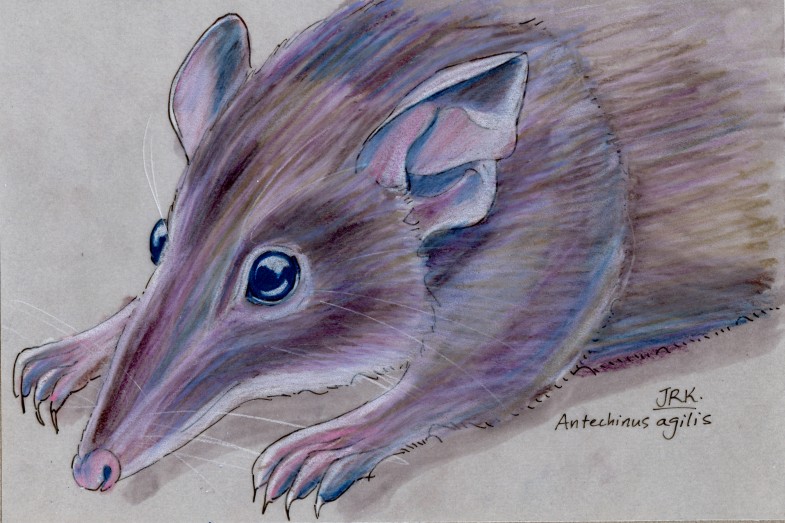
Agile antechinus, Antechinus agilis

Agile antechinus (click image to enlarge)


0403

This fellow is one of a group of species called broad-footed marsupial mice. They’re small, carnivorous marsupials native to Australia. I drew this sometime last year, I think, and I don’t know where I found this guy because the species is not in any of my books or in my mammal species database. It was first described in 1998, having previously been considered part of the species Antechinus stuartii, the brown antechinus. My mammal species database has always been my final authority on what mammals to draw and what mammals not to. Now here I go, making more work for myself!

Since this is such a new species, there isn’t a whole lot for us to find out about it yet, but I do know that it has the same mating habits as the brown antechinus, which are truly fascinating and pretty horrific to those of us who aren’t antechinuses. I wrote a decent post about the brown antechinus last year, and you should read it now.

{ 2 comments }

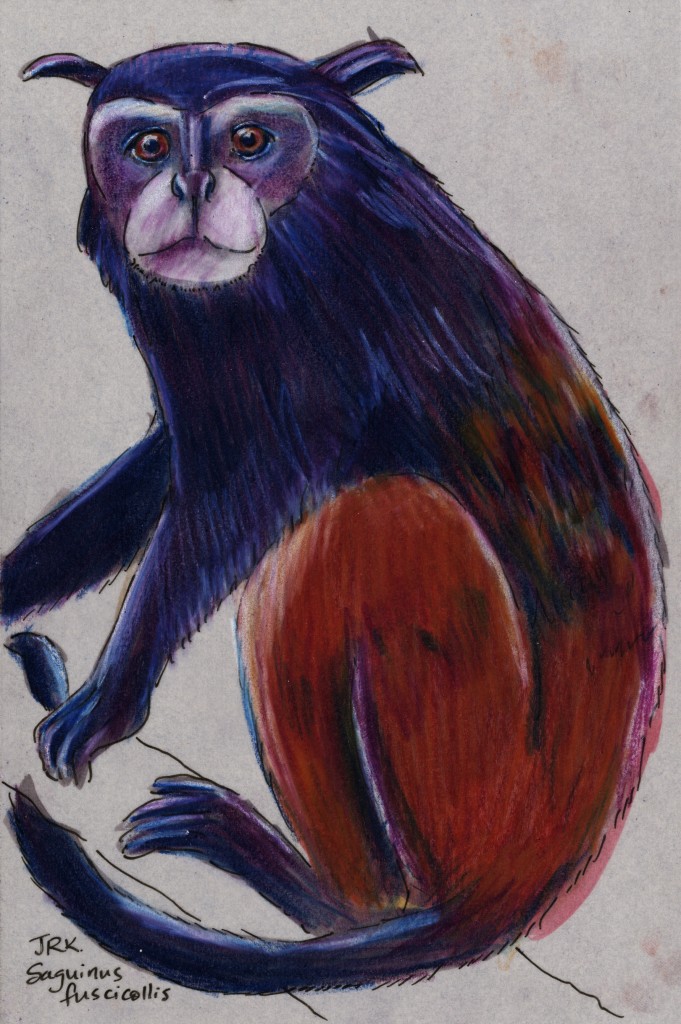
Saddleback tamarin (click image to enlarge)


0356

I’ve decided to go ahead and call this an official theme week. This is the fifth and last entry in our Daily Mammal Mating Week. The saddleback tamarin, which lives in Bolivia, Brazil, Colombia, Ecuador, and Peru, practices polyandry, which means that a single female mates with more than one male. (Polygamy technically refers to a marriage or partnership with more than two partners; polygyny means one male and two or more females. Other members of this tamarin’s taxonomic family also practice polyandry.)

A typical group of tamarins includes one mating female and at least two males, but they’re flexible about their family systems, and sometimes they’re in a monogamous pair accompanied by adolescent offspring or in a group that includes other, non-dominant females, whose ovulation is suppressed and who help take care of the dominant female’s babies, who are nearly always born in sets of twins. All the males take turns mating with the dominant female, and Walker’s Mammals of the World says that “tamarins generally display minimal intragroup aggression, with a marked degree of cooperation and tolerance, even by sexually active males towards one another.” It’s a nice system:

In Saguinus the father and sometimes other adult members of a group assist at birth, receiving and washing the young. The newborn have a coat of short hair and are helpless. They cling tightly with their hands and feet to the body of the mother or father. The father transfers the young to the mother at feeding time and then accepts them from the mother again after feeding…Several members of a group besides the mother and father may help carry and provision the young…

So that’s it for our Mating Week. In addition to today’s polyandrous group, we’ve visited a lek, a barbaric “rape society,” a monogamous pair, and a “big-bang” reproducer. We mammals find what works, and the diversity in that is pretty beautiful.

{ 5 comments }

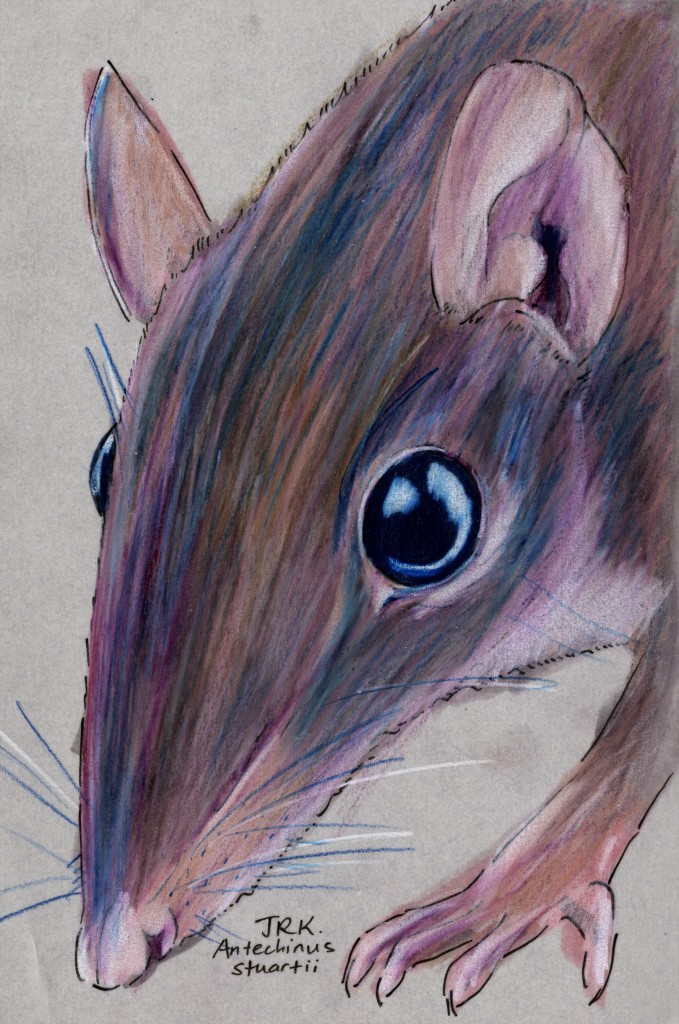
Brown antechinus (click image to enlarge)


0355

Every female wants a good father for her babies. Every male wants a good mother for his babies. That’s what life is all about. The more I study other animals, the more I think the meaning of life is: have sex and have babies, and have sex and babies with a mate or mates of good quality. Is there any other reason that anyone does anything?

But different species have different ways of finding the best mates, and within a species, the two sexes have different methods, too. In most mammals, the males aren’t choosy. They just impregnate everyone they can, and hope that their promiscuity will mean the odds are in favor of their finding at least one good mother for their offspring. Most mammalian females are pickier because they have such a large investment in raising the babies, from gestation to nursing and weaning and carrying their young around on their backs as they swing through the treetops. They can’t produce as many offspring, so they have to make sure the ones they have are good ones. Sometimes this means they look for the male who is best at fighting off other males, or they look for the one who can defend them against predators. Sometimes they look for the one with the most attractive pheromones and the prettiest honking noise, like in yesterday’s Gambian epauletted bat.

Females of the brown antechinus species, a mouselike Australian marsupial, look for the males with the strongest sperm. At least in this species, strong sperm means strong babies—babies who survive infancy, anyway. How do they find the best sperm? They mate with everyone who crosses their path and let the sperm fight it out. A typical brown antechinus litter includes the babies of three or four fathers, and studies have shown that the antechinus fathers who sire the most offspring also sire the strongest offspring—the offspring with the best chance of survival. In the end, according to this 2006 Scientific American article about the brown antechinus, this has the same result as mating with just one really good male.

Some of the males don’t end up actually passing on any of their genes, even though they mate just as much as the others. But they don’t care because they’re dead. You see, the brown antechinus mating system is what’s actually referred to as big-bang reproduction. They engage in two weeks of nonstop sex, some sessions lasting 12 hours or so, and then their poor little systems just give out. The stress of all that mating causes the males to suffer immune suppression and infection and internal bleeding and they all die before their first birthday. The ones with the strongest sperm father babies that will be born after their dads are gone, and the ones with weak sperm die in vain. The females survive long enough to give birth and nurse and wean, but they don’t live much longer than a year themselves. Then the next generation repeats the whole thing the following fall, and so it goes on and on and on.

Coco (age 12) drew a brown antechinus, too:

Brown antechinus by Coco (click image to enlarge)

{ 4 comments }

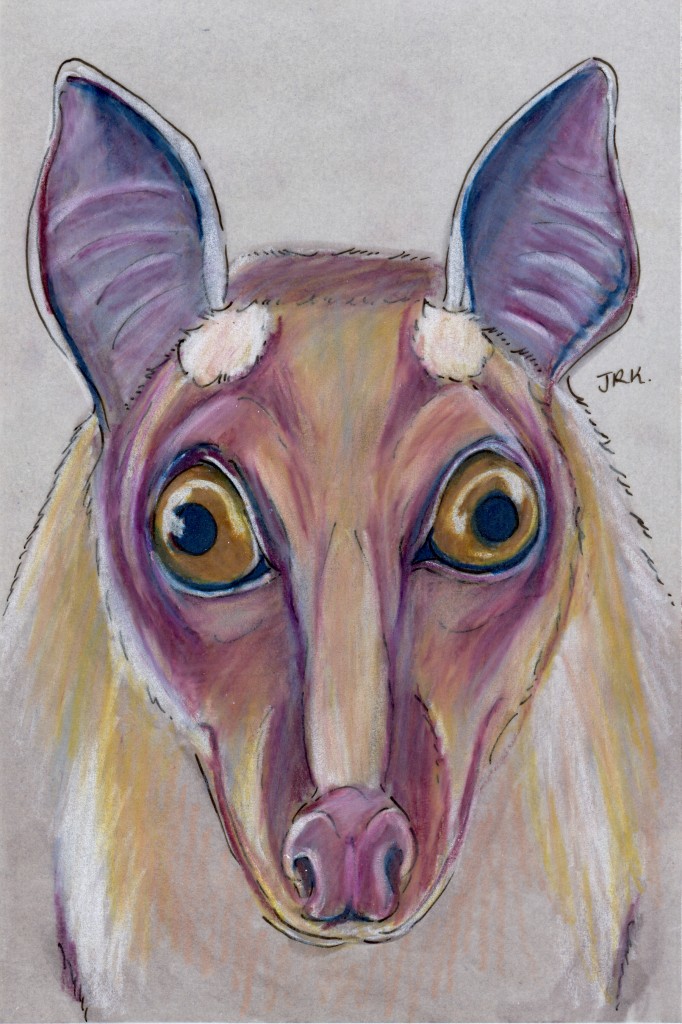
Gambian epauletted bat (click image to enlarge)


0354

Last June, I drew the hammer-headed fruit bat, which is known for its lek mating system. The Gambian epauletted bat, today’s mammal, uses a similar lek system. In Courtship in the Animal Kingdom, Mark Jerome Walters explains leks:

In some animals, however, males offer neither defense of the females nor any particular resource. There is no trade-off of riches, nor any guarantee that the male will help raise the offspring. Such males gather merely to display themselves. The group display is known as a “lek”—a word thought to have come from the Swedish for “sport” or “play”—and the tree, pasture, or other area where they display is known as an “arena.”

According to Walters, male Gambian epauletted bats “gather at dusk, inflate elastic cheek pouches, and emit a singsong honking sound audible for 200 yards or more. The male then unfurls tufts of white hair from pockets on each shoulder—hence the name. These epaulets are thought to contain pheromones. Wafted off into the twilight by the male’s gently flapping wings, they may help to attract a female.”

How neat, isn’t it? They have pockets on their shoulders, from which they unfurl tufts of hair, and then flap their wings to send their pheromones off as an only subconsciously perceptible advertisement for their charms. The males get to the arena as the sun sets, and the females keep them waiting until 11. Then the females get there and hover in front of each male in turn, checking out the epaulets and honking. After they make their choice and mate, the males “retire exhausted by 3 a.m.”

{ 3 comments }

northern elephant seal

Northern elephant seal (click image to enlarge)


0353

There’s so much to say about elephant seals, and yet it’s so distasteful. These guys are rapists and baby-killers. Their necks are discolored by scars incurred during mating or fighting for mates, and one of my books, Wonders of Animal Life from 1928, lists “Sea elephants, frightfulness” in its index. In Living Mammals of the World, Ivan T. Sanderson says that they “present the most grotesque and revolting appearance, especially when they lounge around on shore in great misshapen, heaving masses under a hot sun, moaning, groaning, gurgling, and roaring.” A 1979 article in People about one of the top scientists studying elephant seals includes the sentence, “Says Le Boeuf bluntly, ‘It’s a rape society.’” (The title of the article is “Burney Le Boeuf Finds One Way to Pick Up a Seal of Approval.”)

I have a reprint of an 1874 book called The Marine Mammals of the Northwestern Coast of North America that includes a graphic account of the brutal way elephant seals were hunted for their blubber. Trust me, you probably don’t want to know, yet it’s not much worse than what the seals do to each other—except the blubber-hunters nearly drove the seals to extinction. Now they’re pretty healthily back in business in their habitat along the Pacific coast of North America.

And what is that business? Well, a dominant male controls a harem of females and can mate with them whenever he pleases. If a female objects, he holds her down with his massive body weight—up to three tons, and two or three times as much as the female weighs—and forces himself on her. Females have light-colored necks from all the scars they get when the males bite them during mating.

If a non-dominant male tries to mate with one of the females, the female starts screaming, which attracts the dominant male to defend his territory. At that point, he’ll get in a fight with the non-dominant male—a big, bloody fight, as any fight between two creatures that weight two tons would be. They beat each other with their noses and thrash around, sometimes suffocating other elephant seals in the process, especially babies. From Courtship in the Animal Kingdom by Mark Jerome Walters (1988):

Every spring along certain California beaches, bulls engage in bloody competition for female seals. The fight begins as a gruff shouting match with two males exchanging deep-throated roars. If one doesn’t retreat, then the shouting match escalates into combat…[T]hey slam their bludgeonlike noses into each other while trying to sink their large teeth into the neck of their opponent. Newborns are the most frequent victims as males throw their weight around, and the beaches resound with the shrill cries of crushed infants. Nearly half of the pups’ deaths in a single season are caused by battling males.

Walters goes on to say that sex is one of the major reasons for conflict among animals. “Spring is also the season when life’s astounding variety comes clearly into view—a richness that owes much of its existence to sex. And to which the world owes much of its woe.”

It certainly sounds like elephant seals lead woeful lives, and I’m glad that we humans have stopped contributing so murderously to their travails. But we are messing things up for them in another way, and that’s climate change. It seems that in warmer years, females give birth to more male babies. This is apparently because males and females have different feeding grounds. When it’s warmer, the food resources are more diffuse, and the females have to go further to find something to eat. If they have male babies, they won’t create competition for themselves the way they would if they had female young. So they’ve adapted to give birth to males when the weather is warm. Global warming could cause the proportion of male elephant seals to increase, which would mean more competition and more of the violence I discussed above. It could also mean that females have a harder time finding food, which would mean they’re undernourished and less likely to survive.

{ 4 comments }

Klipspringer

Klipspringer (click image to enlarge)


0352

The klipspringer is a little-bitty antelope that lives in eastern and southern Africa on rocky cliffs. I originally picked it for my planned Mammal Mating theme week because it is a rare example of a monogamous mammal. (Most birds are monogamous; most mammals are not.) And what’s interesting is why it’s monogamous. And I also find it interesting that we humans—just apes, really—are able to reason out why other animals do things by analyzing their behavior and habitats and things like that.

Klipspringers are monogamous because monogamy gives them their best chance at avoiding predators. Most small mammals avoid predators by what’s called crypsis—either camouflaging themselves or hiding—or by running away. Klipspringers avoid predators by climbing up onto clifftops where it’s hard for predators to get and where the klipspringers can watch for trouble. But their food is at the base of the cliffs, and if your head is down and you’re eating, it’s easy for a lion to sneak up on you.

So klipspringers pair off—one male and one female—and take turns being lookout while the other eats. The female has to eat more, and also has to bear the children, so the male spends more time and energy watching for predators. The male’s increased alertness allows the female to be more relaxed and concentrate on reproduction and raising her babies. It’s also the male’s job to make sure the female never gets too far away—usually within five meters. She just munches along, knowing that he’ll keep track of her and let her know if trouble is near. (This is also more or less why I got married.)

It makes sense that a pair is the best size group for this. A male with a harem herd would have trouble keeping track of so many gals, and a large herd of males and females wouldn’t be able to so easily get up on the cliffs and away from danger. And a pair of females would both have to eat more to support reproduction and baby-raising, so neither of them could concentrate on guarding.

{ 2 comments }

Wrinkle-faced Bat (Centurio senex)

by JR Kinyak on February 28, 2011

in Bats,Theme Weeks

wrinkle-faced bat

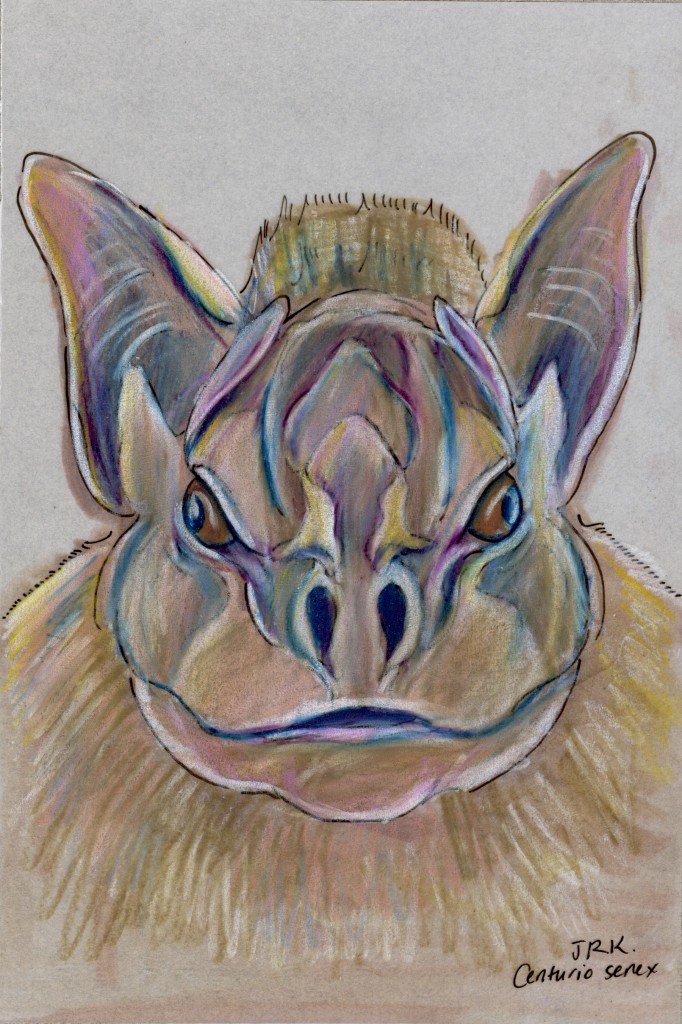
Wrinkle-faced bat (click image to enlarge)


0351

When I drew this guy, I was working on a Mammal Mating theme week, but that was several months ago, and now I can’t figure out what’s interesting about the wrinkle-faced bat’s mating habits, except that scientists speculate that the wrinkled face may be related to sexual selection. Only the males have big neck flaps, and they emit a musky odor from their chin regions, and why would males emit a musky odor from their chin regions if not to attract females?

The flaps at the male bats’ necks are so big that when they’re resting, they flip the flaps up to cover their entire faces. I thought it might be to keep light out so they could sleep better during the day, but then I learned that they have translucent patches over the eyes! Pretty amazing.

This article from the Journal of Zoology (link is to a PDF) uses words like bizarre, extraordinary, unusual, exceptional, enigmatic, and dramatic in describing the bat’s strange face and head. The wrinkle-faced bat is frugivorous, meaning it eats fruit, and the article’s authors conclude that it’s likely that the shape of the head, anyway, is in service of the bat’s strong bite, which perhaps helps it eat harder fruits and therefore survive when weaker-jawed frugivores wouldn’t. Usually, when a bat has strange facial folds, it’s thought that the wrinkles help focus the bat’s sonar so it can better catch insects. But this fruit-eater obviously doesn’t need that kind of help. I read one theory speculating that the wrinkles could channel fruit juice into the bat’s mouth.

The scientific name Centurio senex means “100-year-old man.”

{ 4 comments }