Posts tagged as:

dog

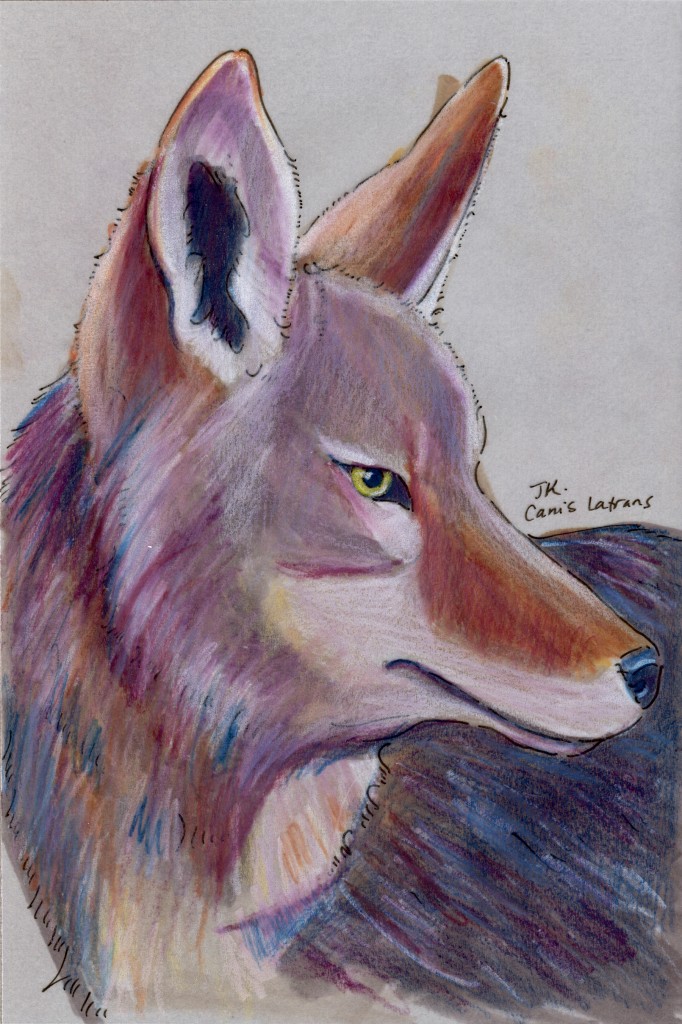
Coyote (Canis latrans)

by JR Kinyak on September 21, 2011

in Carnivores

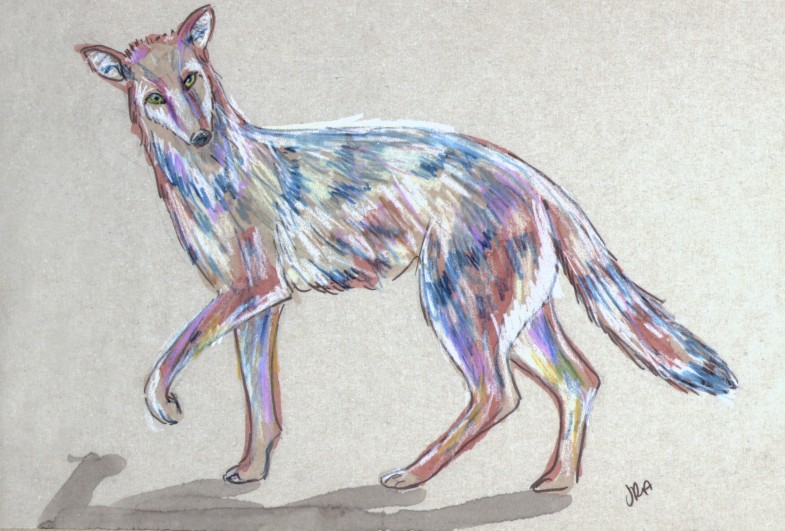
Coyote (click image to enlarge)

Here’s an idea! Why don’t I point you to two embarrassingly bad old drawings in a row? I drew the coyote as mammal number 65, way back in 2007 (oh God, it’s been four years and I have barely a year’s worth of mammals…). Look how my drawing style has changed: very much for the better, yes? Looking over that post is bittersweet because the drawing was by request of Maleta Scrivner, a lifelong family friend who has since died. I wish I could have drawn her a better coyote back then, but heck, I think she liked just about anything I drew, or at least that’s what she let me think!

In homeschool this year, we read a book that my dad bought for me when I was 8, Coyote & by Joe Hayes. It’s a collection of Native American coyote trickster stories, and I think we’d all highly recommend it. One thing we learned was that if you want to make Coyote laugh, call him by the secret name that always gets him tickled: Yellow-Behind-the-Ears.

Here’s Coco’s drawing of the old trickster.

Coyote by Coco, age 12

{ 1 comment }

Today is the final day of our fundraising effort to help Japan. These two drawings, along with the few that remain from earlier in the week, are for sale, with their entire purchase price going to help people and animals affected by the earthquake and tsunami in March—half to the American Red Cross, half to Animal Refuge Kansai, an animal shelter in Japan. Please help!

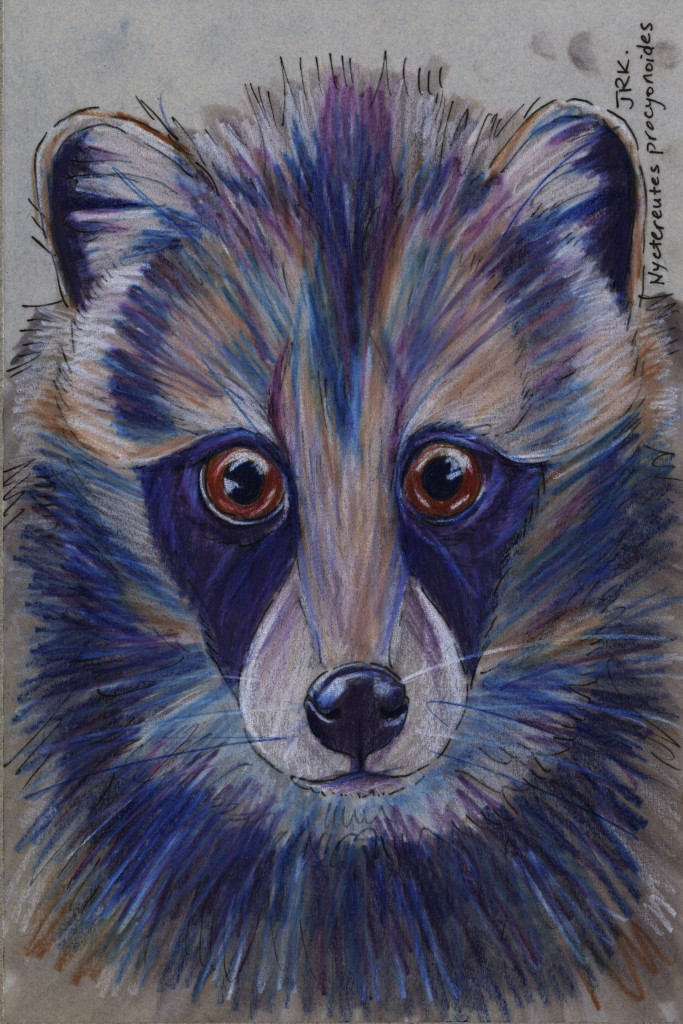
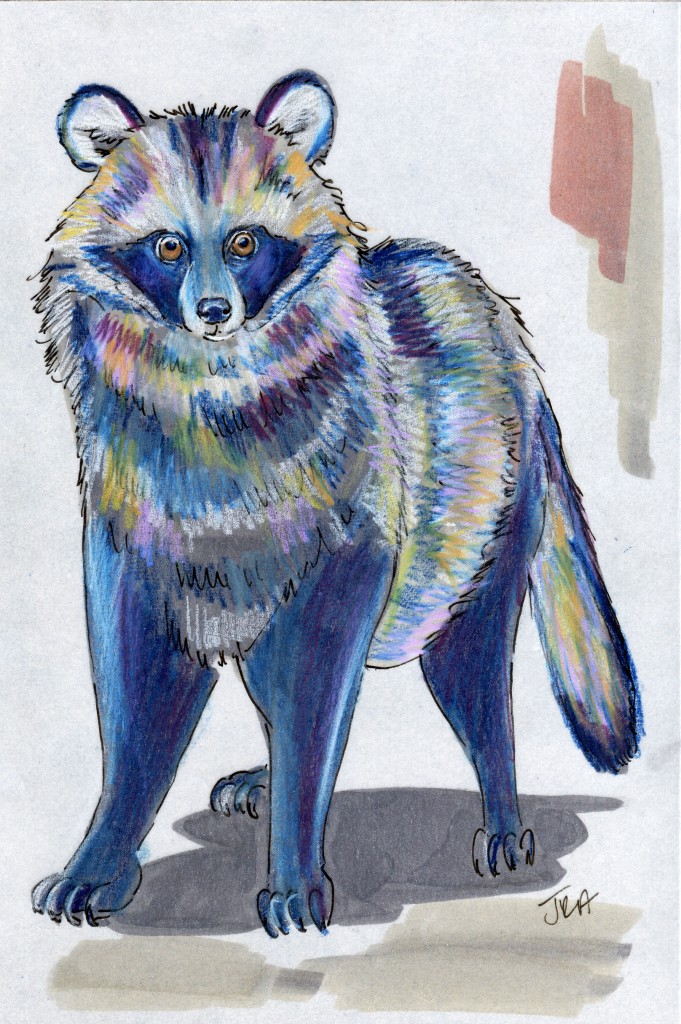
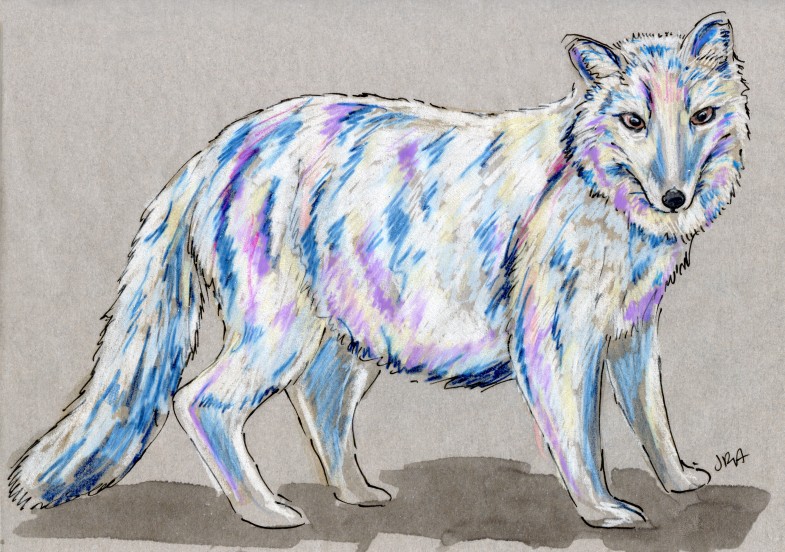
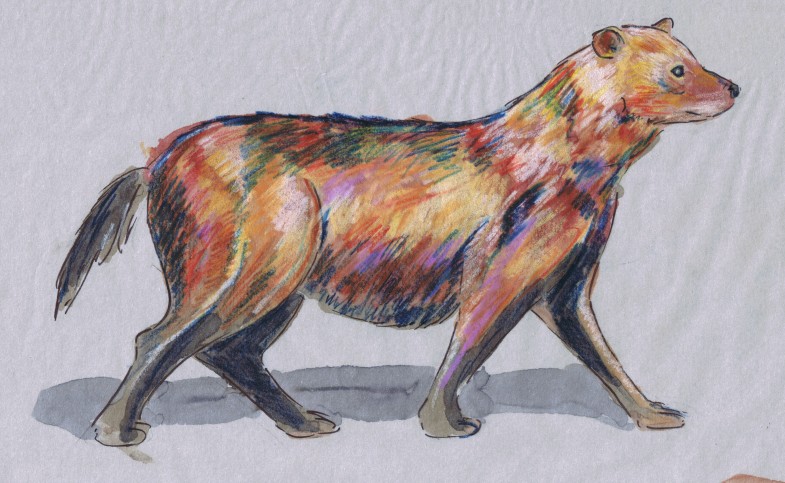
Raccoon dog (click image to enlarge)

This drawing has sold!

Besides today’s portrait, I drew the raccoon dog once before, back in February of 2009 during Hibernators Week—it’s the only canid that hibernates, which is interesting. But even more interesting is its position in Japanese legend. I shall quote from my own previous post, even though it feels a bit lame to do so, especially on the last day of our Mammals of Japan Mammalthon. Ah, well…

In Japan, where the raccoon dog is called the tanuki, the species is pretty common and can even be found in some urban areas. The tanuki is an interesting figure in Japanese folklore. It’s a shapeshifter and a bit of a trickster, and tanuki statues can bring good luck. The most interesting and, to me, strange element of the tanuki legend is the animal’s remarkably large scrotum, which it can use—in myths and stories now, not in real life!—as shelter from a storm or as a net for catching fish. I recommend this baffling series of 19th-century comic prints that show some of the tanuki’s creative uses for its endowments.

Seriously, check out those prints. You will be amazed. Perhaps envious. You may be inspired to buy your own tanuki art—no, not an expensive print from the 1800s, but an affordable original drawing!

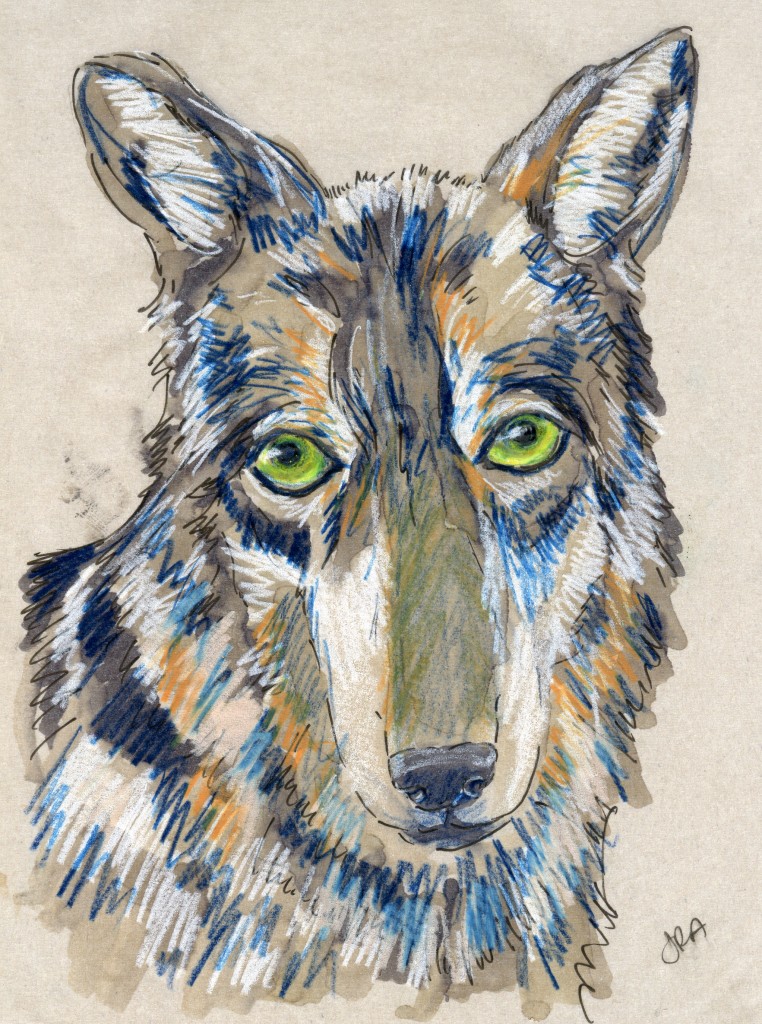
Raccoon dog by Coco, age 12 (click image to enlarge)

Coco’s drawing has sold!

Thank you for your support, comments, and visits during our week-long visit to Japan. We are so saddened by the devastation there, and we’re glad that—with your help—we could help, even if our help is small. In drawing and researching these mammals, I’ve been reminded just how beautiful and special Japan is. I hope reconstruction and recovery is smooth, and my heart aches for those who lost loved ones.

{ 4 comments }

Black-backed Jackal (Canis mesomelas)

by JR Kinyak on July 1, 2009

in Carnivores

canis_mesomelas_72

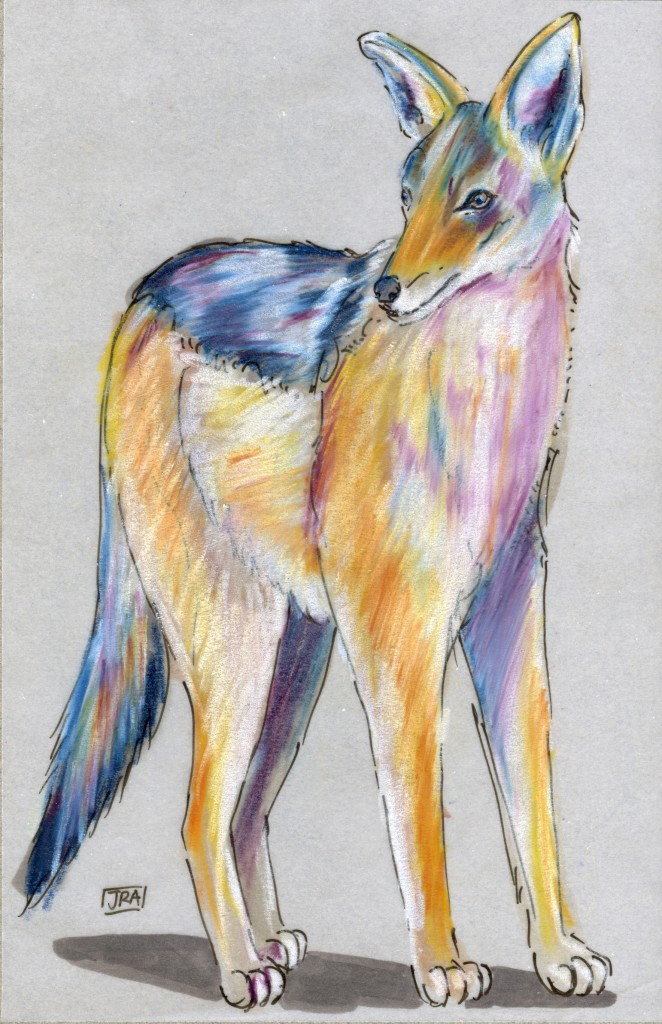
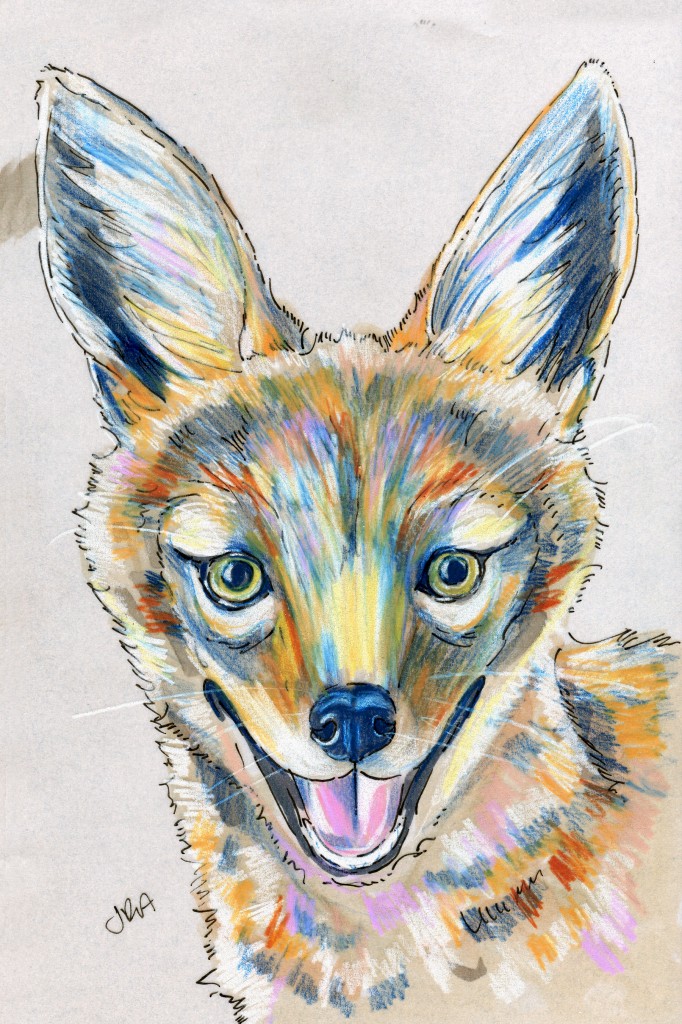
Black-backed jackal (click image to enlarge)

0263

Hello, mammals, and thanks for your patience through the long hiatus I seem to have taken from drawing and posting! We’re back in the swing of things now with this black-backed jackal, who lives in two separate parts of Africa, one in the east and one in the south. There is some controversy about who’s a jackal and who isn’t, but my copy of Walker’s indicates that there are four jackal species. This is the second featured on the Daily Mammal. (Here’s the golden jackal, which I drew a while back.) We’re halfway through with the jackals!

The black-backed jackal is both a scavenger and a predator. It will eat nearly anything: other mammals, birds, reptiles, insects, plants, whatever. It can band with other jackals to bring down a gazelle or antelope, or it can follow lions around and eat their leftovers. Black-backed jackals have been known to work cooperatively with cheetahs to bring down a tasty dinner. Ivan T. Sanderson, in Living Mammals of the World, says, “Their name has come to be applied to all forms of unpleasant hangers-on—a result of their habit of following the large cats, making a special noise when doing so, and then eating up most of the feast as soon as the cat’s back is turned.” I say it’s the cats’ own fault: if someone’s following you and making a special noise that indicates he wants your food, don’t turn your back!

Black-backed jackals live in groups of up to eight or so, at the core of which is a mated pair. A pair may stay together for several years. Adolescent jackals stick around to help their parents raise new babies. In some desert parts of their habitat, black-backed jackals can apparently go up to nine months without drinking water.

{ 1 comment }

Bat-eared Fox (Otocyon megalotis)

by JR Kinyak on May 8, 2009

in Carnivores

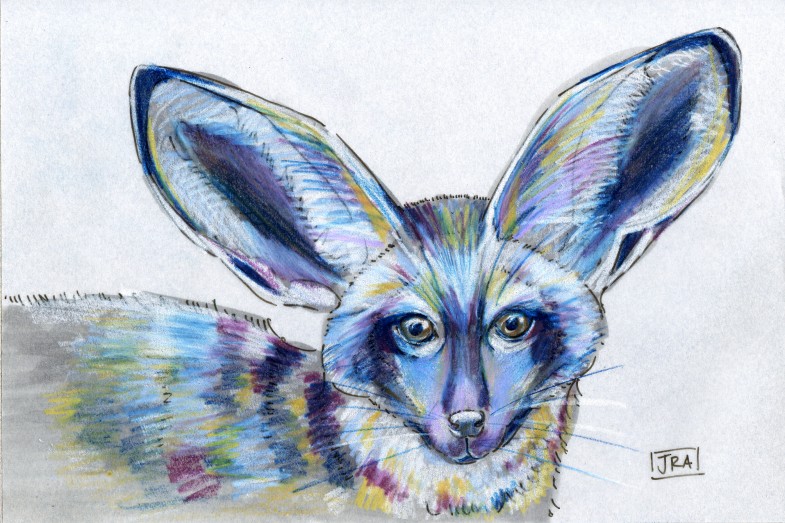
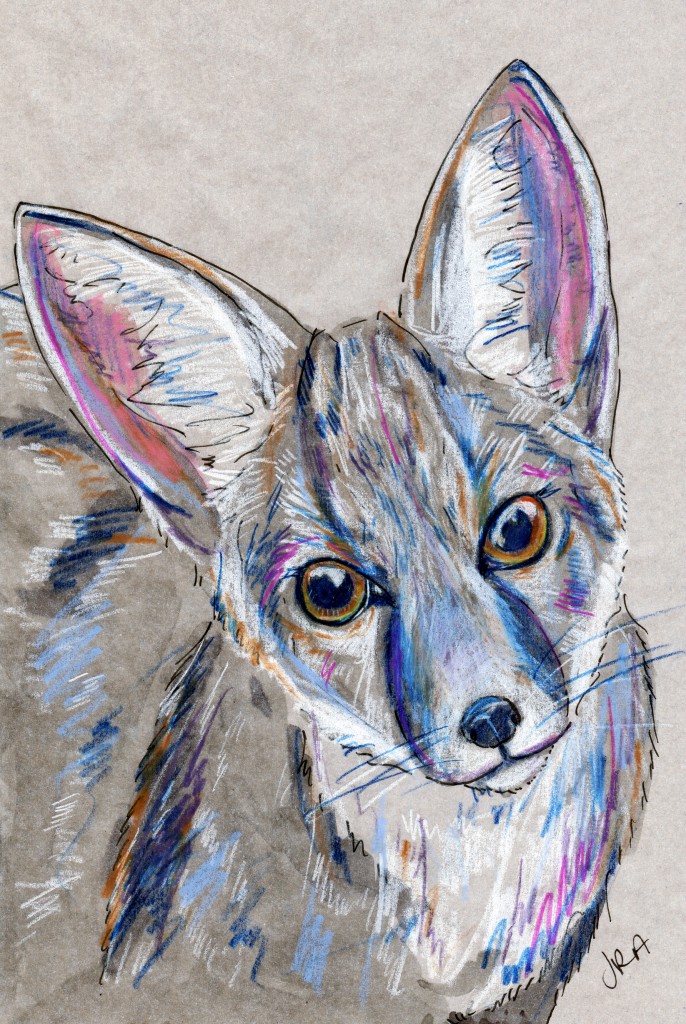
bat-eared fox (click image to enlarge)

bat-eared fox (click image to enlarge)


0259

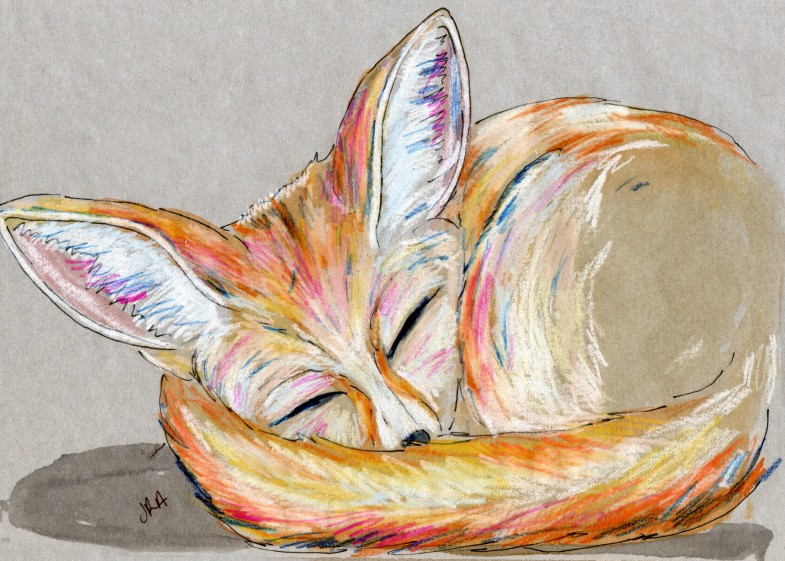
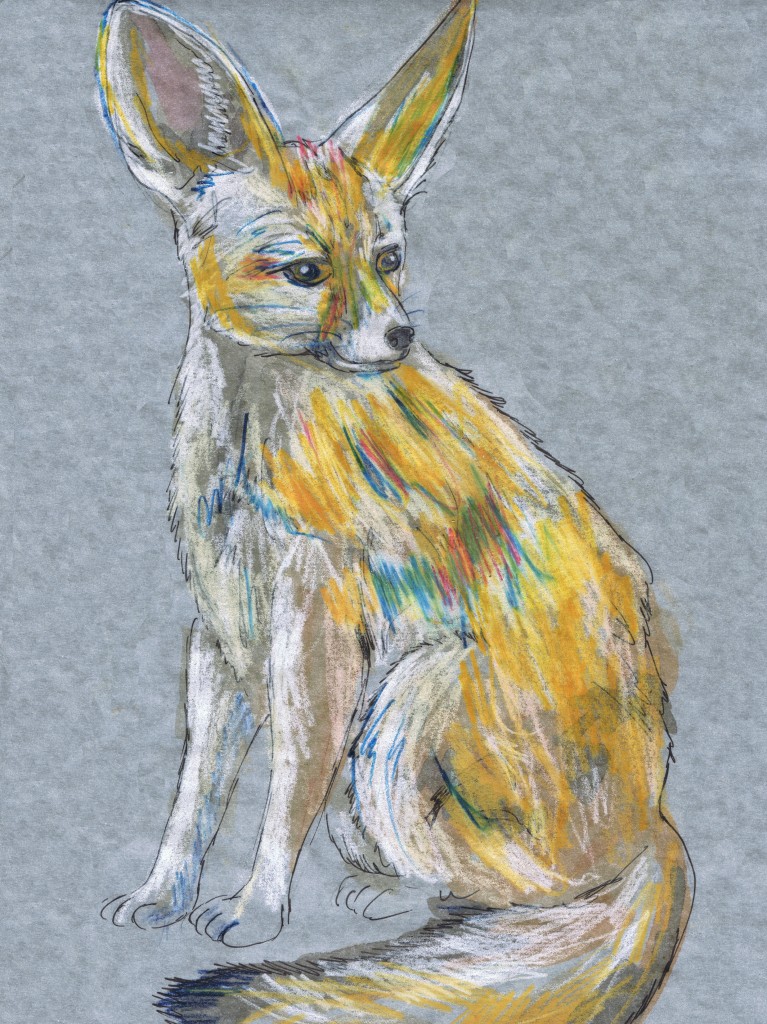
Well, that’s an apt name! This fox (whose scientific name translates into something like ear-dog big-ear), lives in two separate areas of Africa that are about 1,000 km (621 miles) apart. One is in the eastern part of the continent, ranging from Ethiopia and southern Sudan to Tanzania, and one is in the south, from southern Angola to South Africa. Depending on where they live, bat-eared foxes eat insects, other arthropods, rodents, birds’ eggs, and plants. They’re especially keen on termites and dung beetles.

Besides those extra-large ears (which they use for sending each other visual signals as well as for hearing, and I wouldn’t be surprised if they serve a cooling purpose, too, out there in the desert), the bat-eared fox has unusual dentition, which means the arrangement of its teeth. May I throw around some more mammalogist jargon just to impress you? The bat-eared fox has more teeth than any other placental, heterodontal mammal. That means it has a lot of choppers. Okay, specifically, it has the most teeth of all of the non-marsupial mammals that have kinds of teeth that are different from each other. For instance, humans: we’re placental with heterodontal dentition. But our pieholes are not nearly so crowded with the ol’ pearly whites.

{ 2 comments }

click image to enlarge

0224

Guess what! The raccoon dog is not endangered. In fact, in some parts of its range, it is considered a nuisance! How exciting for us, don’t you think?

The raccoon dog is in the canid family, although it does resemble a raccoon, especially facially. It originally lived from Siberia to Vietnam, as well as throughout Japan, but it was introduced into Russia to provide more work for fur trappers. Now it has made its way into northern Europe, and has been found in France, Germany, Sweden, and Finland, among other countries. It is the only canid that hibernates (torpor, I think, not “true” hibernation), although in warmer parts of its range, it doesn’t.

In Japan, where the raccoon dog is called the tanuki, the species is pretty common and can even be found in some urban areas. The tanuki is an interesting figure in Japanese folklore. It’s a shapeshifter and a bit of a trickster, and tanuki statues can bring good luck. The most interesting and, to me, strange element of the tanuki legend is the animal’s remarkably large scrotum, which it can use—in myths and stories now, not in real life!—as shelter from a storm or as a net for catching fish. I recommend this baffling series of 19th-century comic prints that show some of the tanuki’s creative uses for its endowments.

{ 5 comments }

click image to enlarge

0193

Golden jackals live not only in Iraq, but throughout northern Africa, Asia, and up into southern Europe. They mate for life, living in tight little family packs. They have one litter a year, and each time, a couple of their offspring stay on with their parents to help raise the next litter. These big brothers and sisters are called “helpers” and are vitally important to a jackal family’s survival, offering assistance in guarding, hunting, and regurgitating food for the little ones. Speaking of food, golden jackals like to eat eggs, birds, other small animals, baby gazelles, and fruit. They also enjoy taking lions’ leftovers, and they’ll bury their scavenged food if another animal happens upon the feast. The golden jackal is the last animal we’ll meet in this Mammals of Iraq series.

Incidentally, I want my husband Ted to start writing an advice column called “Help! My Jackal Looks Like a Cat!” He says there’s no market for it, but I think the demand’s there. What’s your opinion?

Consecutive days of mammals: 3
Record: 16

{ 3 comments }

New Feature: Mammal News Roundup

by JR Kinyak on May 18, 2008

in Mammal News

Sometimes I see articles online or in magazines that I think would interest Daily Mammal readers. When they concern mammals I haven’t drawn yet, I can feature them as Daily Mammal Now posts. But when I’ve already drawn them, or just don’t want to or can’t draw them right away for some reason, I don’t have a good vehicle to share them with you.

That’s why I’m going to start occasionally (weekly? fortnightly? semiweekly? who knows?) pointing you to some very recent news stories and articles that you might want to read, or at least know about. Here’s the first Mammal News Roundup.

Daily Mail, May 12, 2008: There’s a cow the size of an elephant.
He was left on the doorstop of an English animal sanctuary when he was an infant. The first picture makes him look especially large; check it out. Note to Americans: swede is what Brits call rutabaga.

Science Daily, May 13, 2008: Double mammal newsflash: In Brazil, they’re training dogs to recognize the scent of various endangered mammals (like the jaguar and the giant anteater), helping researchers monitor their populations.

Madison, Wisconsin’s Capital Times, May 13, 2008: They’re still trying to figure out what’s causing white-nose syndrome, the strange ailment that’s devastating some populations of bats in the northeastern United States. (Click on the Daily Mammal Now link above for more.)

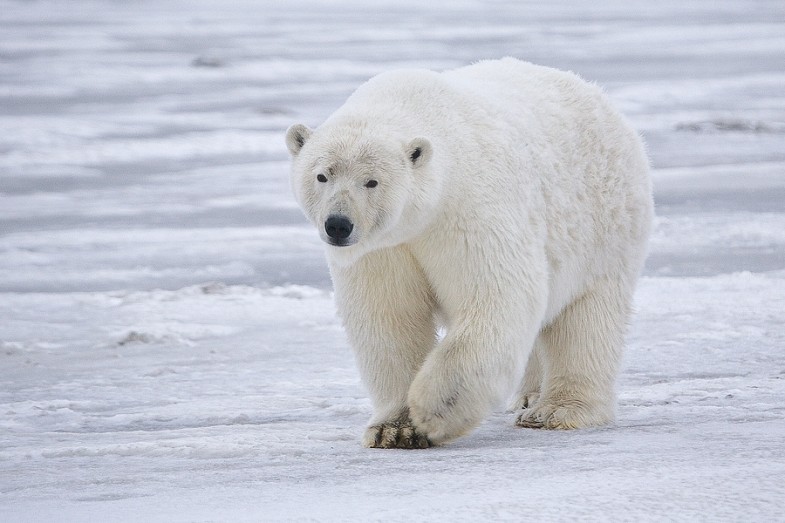
U.S. Department of the Interior news release, May 14, 2008: Polar bears are now listed as a threatened species under the Endangered Species Act. Since climate change is a major cause of polar bears’ decline, but it’s very difficult, to say the least, to prove how any particular action by Americans influences the climate change that’s harming the bears, it is unclear how much the move will help the bears.

When I drew the polar bear, I found in my research that some people think that the polar bear is actually the same species as the brown bear. I looked into that a little more today and learned some interesting things. It seems polar bears, which are recognized as a distinct species by most anyone without an ax to grind, evolved from the brown bear pretty recently, some 200,000 years ago. And they were still developing adaptations as recently as 40,000 years ago.

I wonder how you would decide when the species was still the brown bear and when it had become the polar bear. Maybe there’s a bare minimum of changes and differences that must be present? Or a certain number of DNA markers that should be present or absent? Or is it a case of “you know it when you see it”?

Some people, evidently regarded as nuts by some other people, think that melting ice in the Arctic will force the polar bear to evolve back into the brown bear, but it seems pretty likely to me that they’re endangered enough that we can’t expect them to be around long enough for that to happen with no intervention. Being an amateur biologist, though, I can just speculate.

BBC News, December 10, 2007: An Icelandic (yay!) scientist found the most ancient polar bear jawbone we have,
a 150,000-year-old specimen. The article discusses, in brief, the evolutionary history of the polar bear.

(Polar bear photograph by Scott Schliebe, USFWS)

{ 3 comments }