Posts tagged as:

about drawing

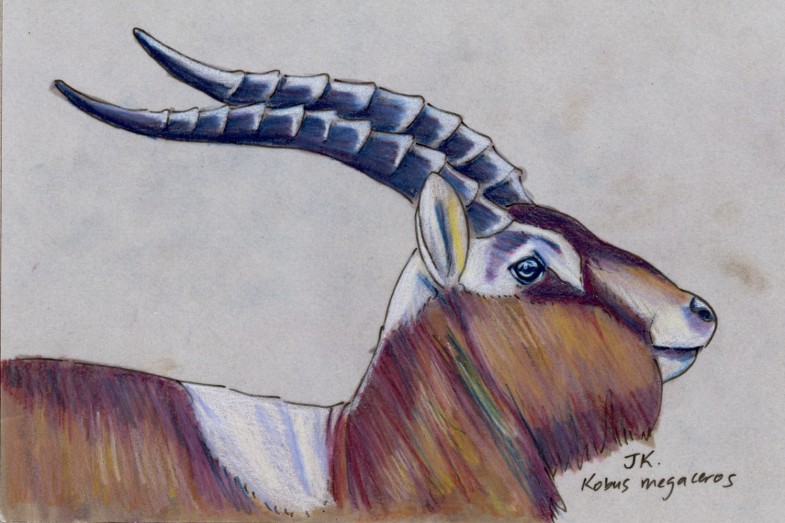
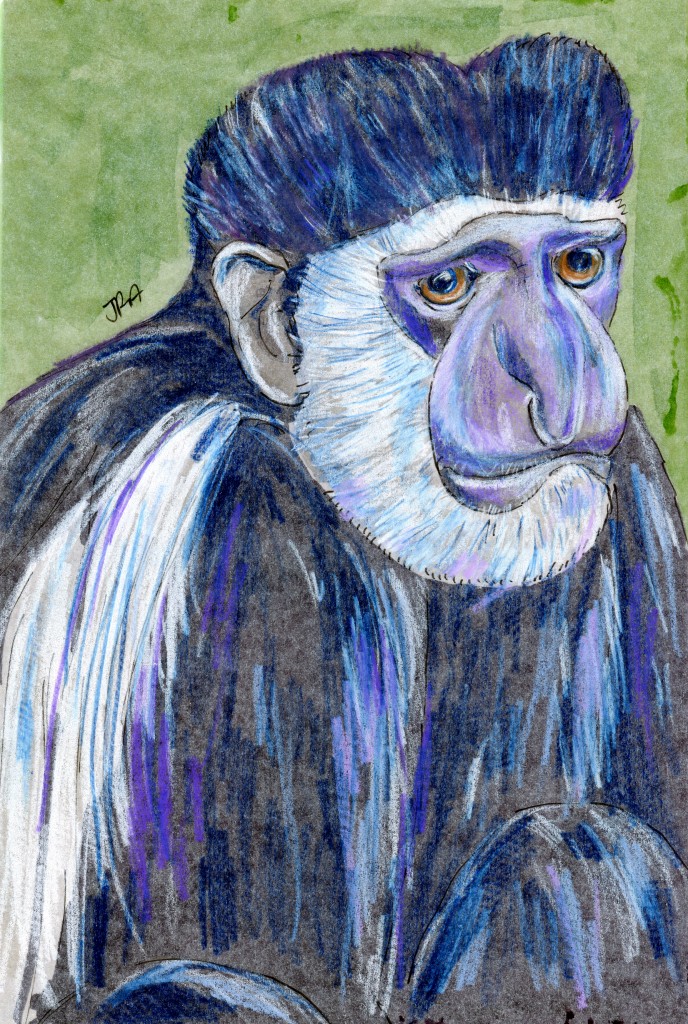
Mrs. Gray's lechwe, Kobus megaceros

Mrs. Gray’s lechwe (click image to enlarge)

0418

Today’s Mammalympian is a fencer. Well, sort of. In human fencing, the object is to touch your opponent with your blade; your opponent uses his or her blade to keep you from doing that, while also trying to touch you. Some mammals carry their “blades” on their heads in the form of horns or antlers, and they’re more likely to attempt to wrestle their opponents to the ground. Maybe it’s more like arm wrestling. But for both humans and other mammals, the ultimate goal is to assert dominance over a rival.

Lechwes are antelopes, and this species spends a lot of time in shallow water. They have extra-long hooves that help them navigate swampy places, and males will apparently spar with their heads underwater. Mrs. Gray’s lechwe lives in Ethiopia and Sudan, and the IUCN lists it as endangered, mostly because of civil war, the displacement and resettlement of humans, and hunting for meat.

portrait of Maria Emma Gray and John Edward Gray from 1863

Mrs. Gray’s lechwe is more commonly called the Nile lechwe, but I’m interested in Mrs. Gray. I spent an hour or two yesterday figuring out exactly who she was, only to discover this morning that my new copy of Mammals: Their Latin Names Explained by A.F. Gotch could have told me. Mrs. Gray was Maria Emma Gray, and her husband, John Edward Gray, was a keeper at the British Museum. He named this species Kobus maria, but someone had already named it Kobus megaceros (megaceros means big horn), and with scientific names, the earlier name sticks. To the left is a portrait of Mrs. and Mr. Gray from 1863. She was 13 years older than him and the widow of his second cousin.

I’ve found a bit of a kindred spirit in Mrs. Gray. Over 15 years or so, she produced a five-volume set of her etchings of molluscs, called Figures of Molluscous Animals, Selected from Various Authors, Etched for the Use of Students. In his preface to her work, Mrs. Gray’s husband writes,

“The tracings from which these Etchings of Molluscous Animals have been taken, were originally made by Mrs. GRAY, for my use, with the view of their being added to my collection of figures of Shells, and to aid me in their arrangement. Hoping that others may find such a collection of figures (many of them copied from expensive works, and brought together from sources not easily accessible to Conchologists in general) as useful as they have been to myself, I induced Mrs. GRAY to make slight etchings of them, which afforded her an interesting occupation when she has been confined to the house by ill health.”

Rather condescending, as I suppose befits a Victorian husband, but Mrs. Gray’s work lives on, and you can look at or download her books at the Biodiversity Heritage Library. Below is a sample from volume three.

etchings of molluscs by Maria Emma Gray

{ 0 comments }

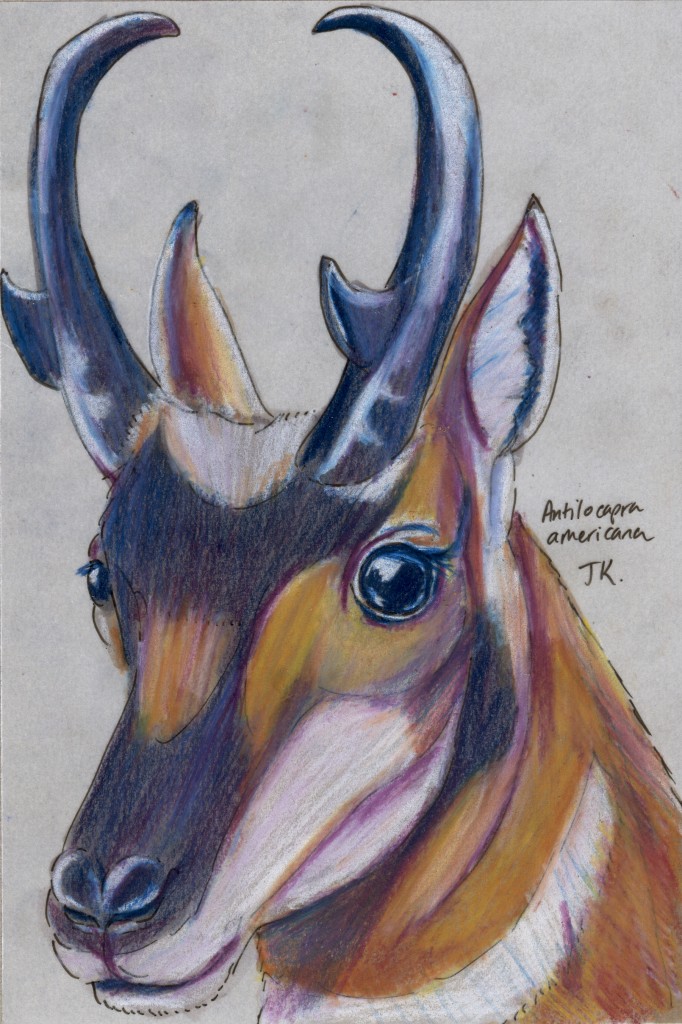
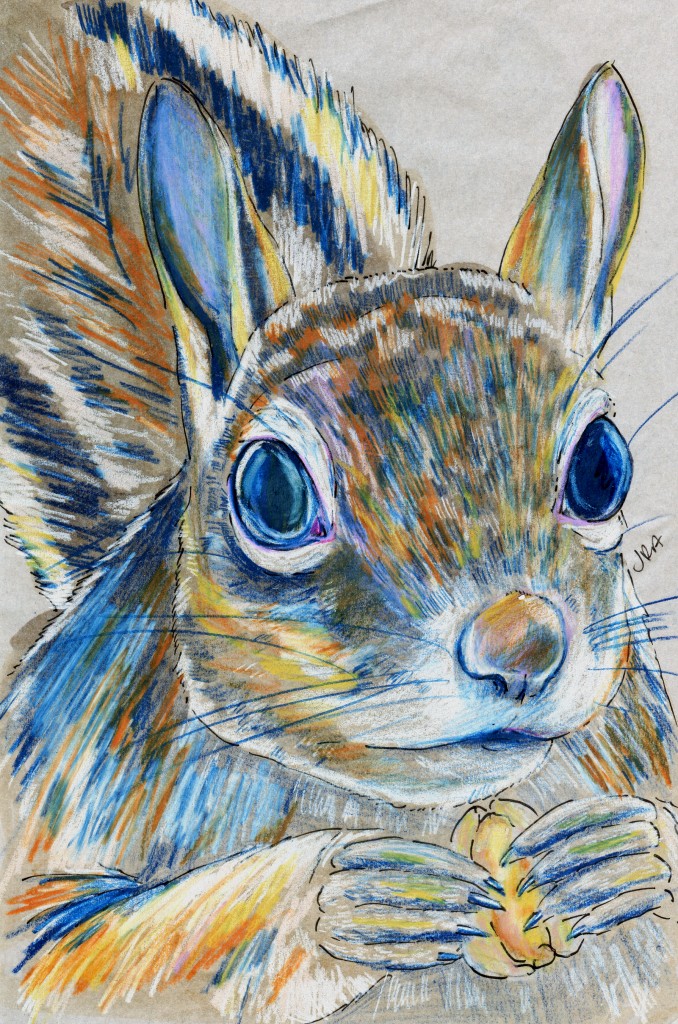
Pronghorn, Antilocapra americana

Pronghorn (click image to enlarge)

The human Olympics start tonight on NBC, and the mammal Olympics start tonight here on the Daily Mammal! We’ll be looking at a few of the best mammalian athletes in the world. The first event is the marathon.

Now, humans are pretty good at marathons. In fact, long-distance running is humans’ best sport. Slate had an article a couple of months ago whose subtitle said it all: “Why nearly every sport except long-distance running is fundamentally absurd.” Other animals beat us easily at swimming, jumping, and sprinting, but we can actually beat most of them at running long distances, thanks to our big butts, springy legs and feet, and maybe especially our prodigious sweating. We probably evolved this amazing ability before we developed all our handy hunting tools so we could run down our dinners. While wolves and other predators usually run maybe 15 miles in a day, humans routinely run not only 26.2-mile marathons but 50- or even 100-mile ultramarathons. (Not all humans, obviously. Maybe there are some out-of-shape wolves out there, too.)

Even though we’re really great at running, we’re still not the marathon champions of the animal kingdom. That honor goes to the pronghorn antelope, who is not really an antelope at all but actually the only surviving species of the Antilocapridae family, and one of my favorite mammals because it lives here in New Mexico and I’ve seen it my whole life. The pronghorn, in fact, is the world’s second-fastest mammal, and would easily beat a cheetah in any race longer than a quarter of a mile, according to this article from Popular Mechanics. The same article estimates the pronghorn’s marathon time at 45 minutes; the fastest human marathoner takes more than two hours.

I drew the pronghorn four years ago, too, and that post is worth reading to hear more about the species’ uniqueness. It has some good comments, too. And as a point of interest, I used the same composition for this new drawing so we can see how my drawing style has changed (improved?) over the years. Here are the two drawings side by side.

An older drawing of a pronghorn next to today's drawing.

Pronghorns from 2008 and 2012 (click image to enlarge)

{ 3 comments }

What I’ve Been Doing

by JR Kinyak on October 27, 2011

in Carnivores,Operations

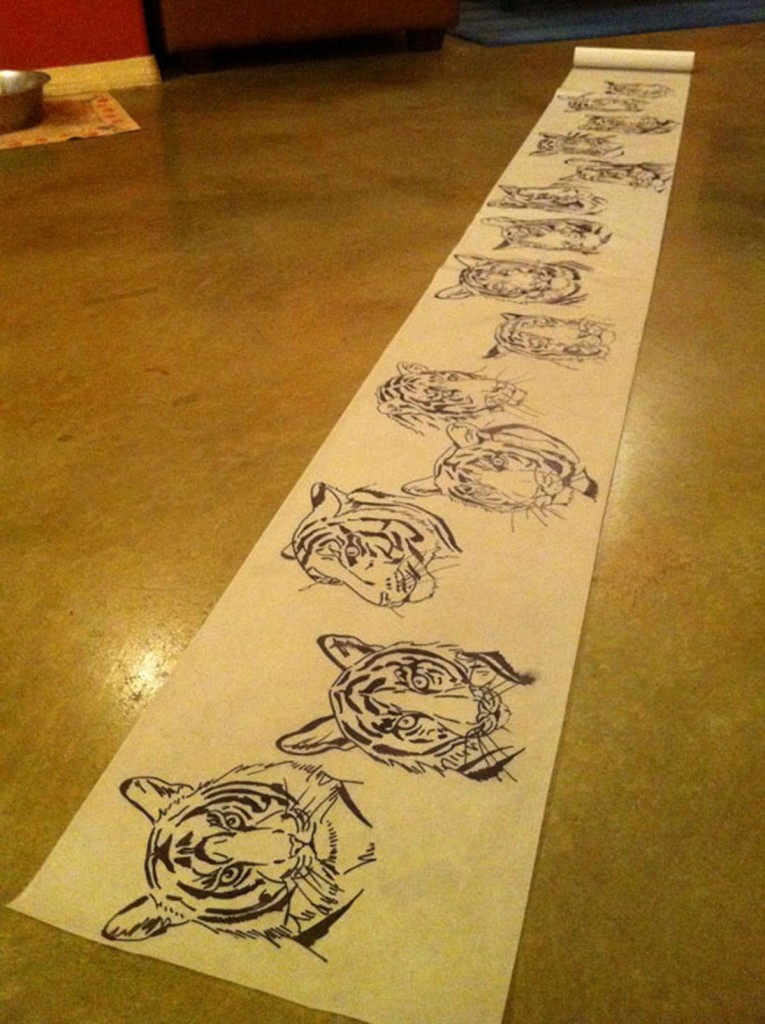
Roll of tigers in progress

I’ve been wanting to write a post about the animals killed near Zanesville, Ohio, last week, but I’m not sure how to say everything I want to say. I did have the idea, though, to draw a tribute to the 49 unfortunate mammals who died, and I’ve been working on it the past several days, which is one reason why there hasn’t been a Daily Mammal for a while.

Tigers in progress

So far, I’ve drawn 14 of the 18 Bengal tigers, though I have yet to color them. I’m not going to color them as elaborately as I do the Daily Mammals, and you can see that I was a lot more general with my line work, too. After the tigers, I’ll draw the 17 lions. Lions are sexually dimorphic and eight of them were lionesses, so they won’t be as monotonous as the tigers. But drawing the tigers has become a bit of a sacred act, in a way, an act of witness and regret.

{ 3 comments }

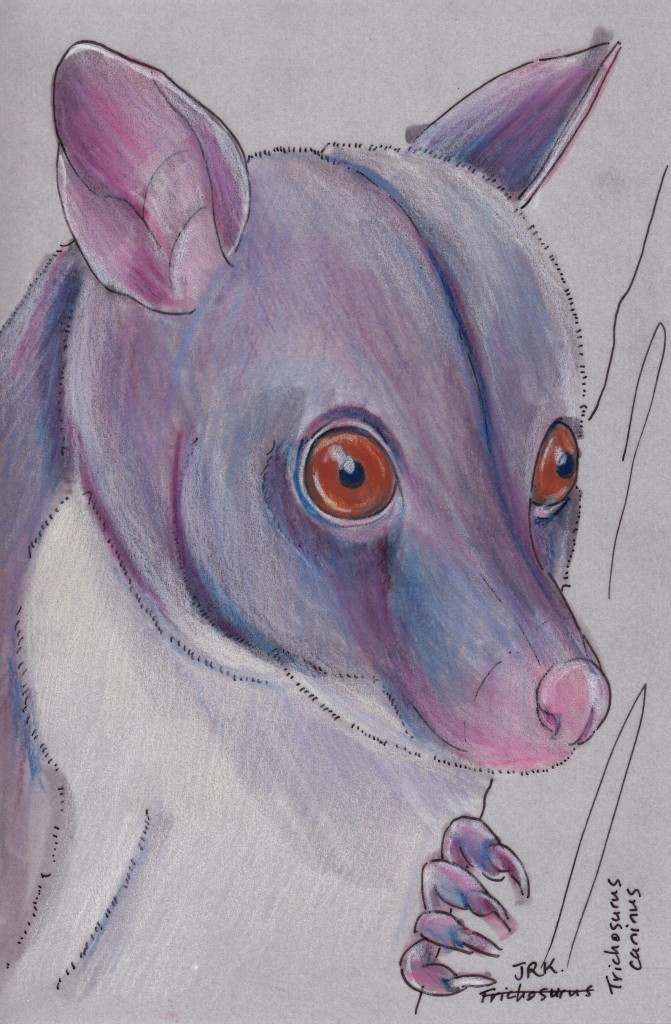
Short-eared brushtail possum (click image to enlarge)

0396

I drew this fellow last week, and just now, sitting down to research him, I ended up tumbling about in my books and online, finding not a lot about the possum—he’s a marsupial who lives in a little-bitty sliver of eastern Australia—but several other bits and pieces somewhat related to the species, which is also known as the bobuck.

For instance, as a spiritual totem, the short-eared brushtail possum could be associated with “mushroom and fungi energy” and both “broadcasting yourself” and “retreating into dark places.” (I don’t mean to sound overly snarky. I’m not into totem animals…at all…well, I don’t know, maybe I am, not in terms of religion or spirituality or trances or deep oneness of the soul, but in terms of affinities and identification, I could get into it. I relate to tree kangaroos and sloths. But I don’t go for the new-agey part of it. Anyway, the woman who runs the above-linked site says she noticed a glut of information about wolves as spirit animals and a lack of attention to marsupial moles, and I love that.) Isn’t the illustration of the possum at that link gorgeous? I quite like it.

Also, I learned that there’s a taxonomic quandary of some kind around this possum. You can read a bit about it at the Australian Museum’s website, but I’m not going to get sucked in. Basically, I just blindly draw the mammals listed in the Smithsonian’s Mammal Species of the World, and that’s that.

Speaking of that list, finding the link to it just now has alerted me that the website has been updated and now has a searchable database. I’ve been working off the spreadsheet they used to have available for download. Now I’ll have to decide whether or not to merge my old list with the new. You think that you can just say, “I know what would be neat—I’m going to draw all the mammals in the world!” But it turns out to be much more complicated than that.

Finally, I picked this possum out of my copy of Furred Animals of Australia, published in the United States in 1947, a book that I’ve referred to often in the past but haven’t thought much about. This time, I decided to Google the author, Ellis Troughton, wondering if he might be a naturalist of the adventurous, tall-tale variety. I don’t think he is, necessarily, but I did learn that he served in World War I in France from 1916 to 1919, and that during World War II he investigated scrub typhus in New Guinea. (I’m not entirely sure what the implications of that fact are.) He was the Australian Mammal Society’s first Honorary Life Member. (Is that a society of mammals? Aren’t they all?) And most perplexing of all, I found a solitary reference, in an interview with a physiologist conducted by the Australian Academy of Science, to Ellis Troughton being nicknamed “Naughty Troughty,” which I guess might rhyme in Australia. Why was he called that? I have no idea. I wish I did, though.

These bits of information inspired me to go through the introductory and…stuff-at-the-end material of Furred Animals of Australia in a quest for more about Mr. Troughton. (What is the word for stuff in the front and back of a book that isn’t the main part of the book? I can’t think of it.) I found, in the back, “Collecting Hints,” in which Mr. Troughton tells us how to preserve the small animals that we may injure in clearing timber or that our cat might bring in. He advises that “every effort should be made to preserve any small mammals accidentally killed about homesteads…The presentation of such specimens to the local museums represents a very material contribution to the knowledge of our unique Australian fauna of mammals.” Even if you’re not in Australia, something to consider, yes?

In the front of the book, Mr. Troughton reprints “A Creed for Nature Lovers” from a 1936 issue of The Australian Museum Magazine, and it’s lovely. It includes “I believe: That we should not harm living things that are harmless to us, as we hope to avoid harmful things ourselves; that even harmful creatures should be controlled with due regard for their zoological heritage and right to survive.” Words to live by, and something I wish I could get my kids to understand when they want to smash every spider that gets into the house.

Speaking of children, in his introduction to the book, Mr. Troughton says:

“Pleading protection’s cause in museum lectures for school children, I have reminded them of Barrie’s Peter Pan, and his friendly fairy kept alive only by the children’s belief in such quaint things. These children will be the grown-ups of to-morrow and both young and old must put their united influence behind any sound movement for the protection of wild life…

“Only by such universal belief in their right to existence can we ensure the survival of most of the fascinating creatures for the delight and instruction of future generations; so that, in the spirit of Kipling’s beautiful ‘L’Envoi’:

Each for the joy of the working,
And each in his separate star,
Shall draw the thing as he sees it,
For the God of things as they are.”

Thanks for joining me while I draw the mammals as I see them.

{ 4 comments }

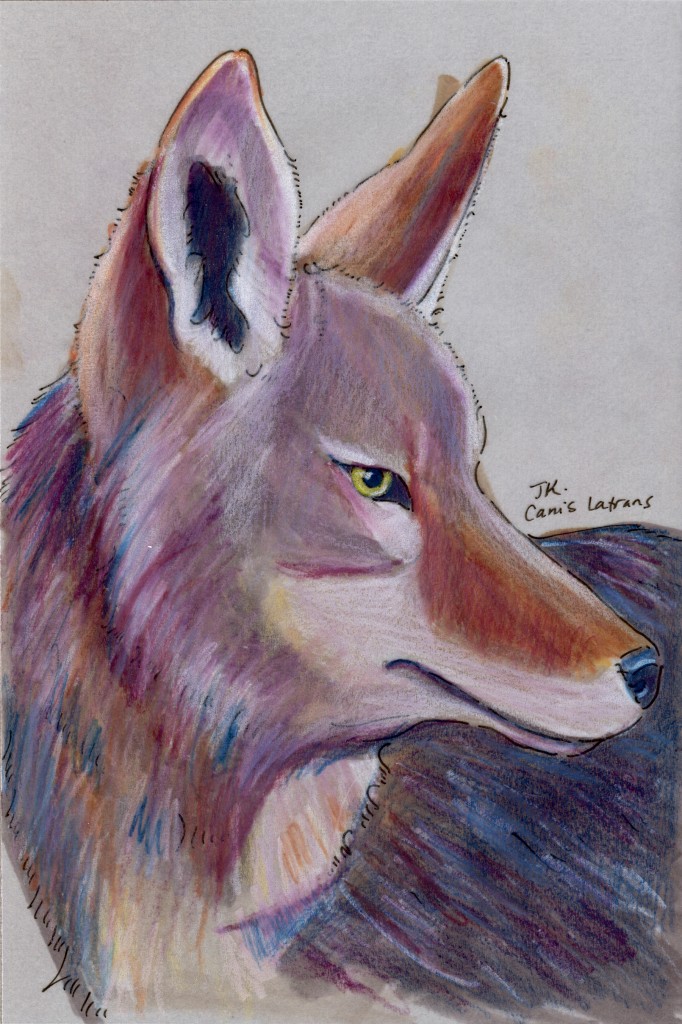
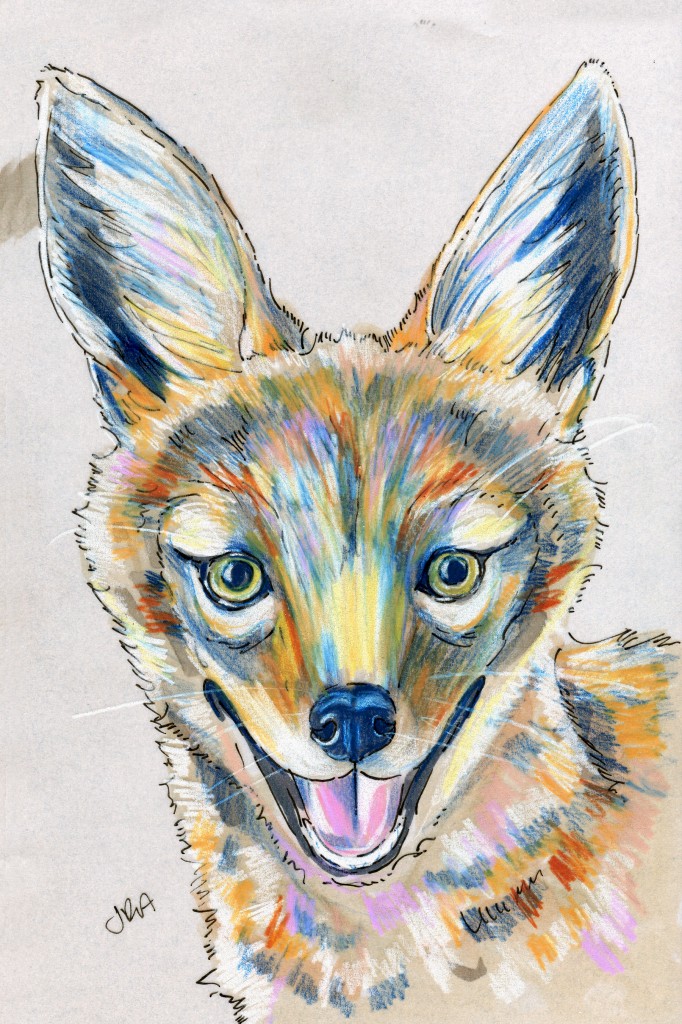
Coyote (Canis latrans)

by JR Kinyak on September 21, 2011

in Carnivores

Coyote (click image to enlarge)

Here’s an idea! Why don’t I point you to two embarrassingly bad old drawings in a row? I drew the coyote as mammal number 65, way back in 2007 (oh God, it’s been four years and I have barely a year’s worth of mammals…). Look how my drawing style has changed: very much for the better, yes? Looking over that post is bittersweet because the drawing was by request of Maleta Scrivner, a lifelong family friend who has since died. I wish I could have drawn her a better coyote back then, but heck, I think she liked just about anything I drew, or at least that’s what she let me think!

In homeschool this year, we read a book that my dad bought for me when I was 8, Coyote & by Joe Hayes. It’s a collection of Native American coyote trickster stories, and I think we’d all highly recommend it. One thing we learned was that if you want to make Coyote laugh, call him by the secret name that always gets him tickled: Yellow-Behind-the-Ears.

Here’s Coco’s drawing of the old trickster.

Coyote by Coco, age 12

{ 1 comment }

Five Random Rodents

by JR Kinyak on April 8, 2011

in Operations,Rodents

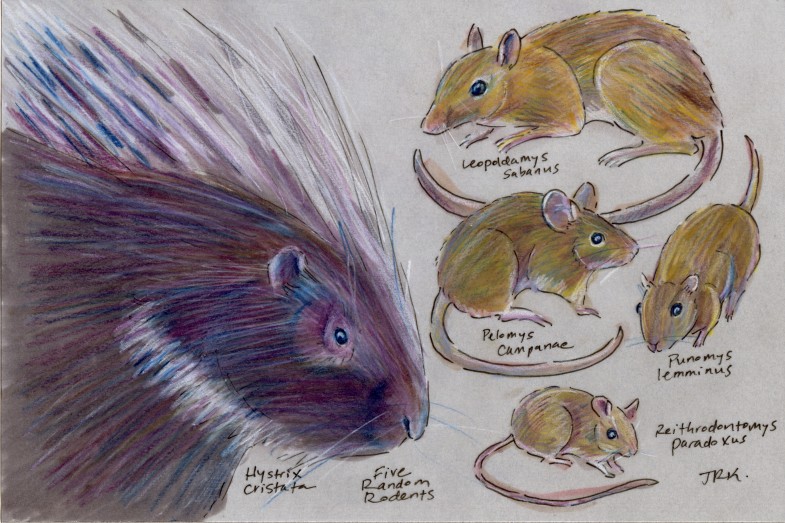
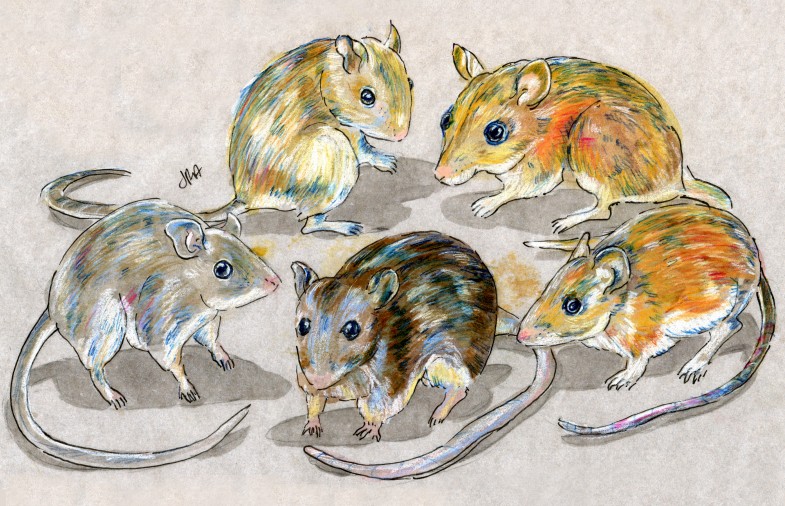
Five random rodents (click image to enlarge)


0379
0378
0377
0376
0380

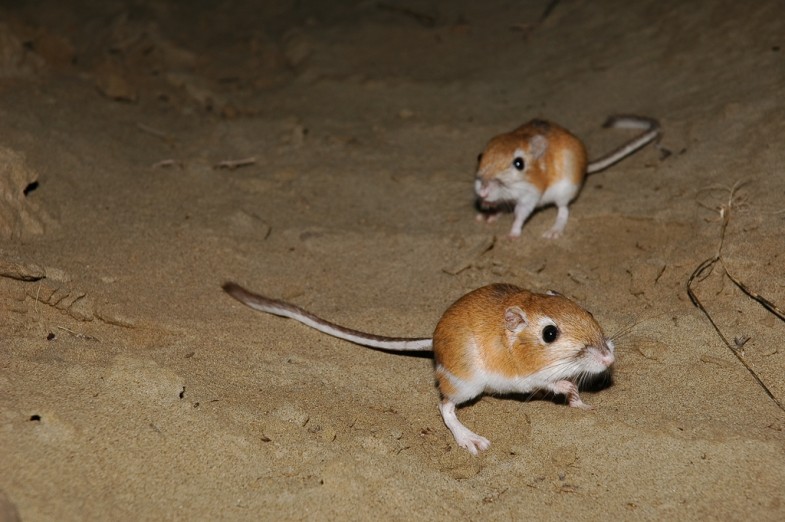
Rodents keep me up at night. I can hear them scritch-scritch-scritching in the attic and the walls. Their whiskers lightly tickle my skin and their buck teeth gnaw on my bones. Their beady little eyes stare at me from every corner, glinting in the dark. Not because my house is infested—it isn’t—but because of the Daily Mammal Rodent Problem.

Of the 5,000-ish mammal species in the world, 40 percent are rodents: small, toothy, bewhiskered, scurrying, and so nauseatingly beige. Tan. Grayish-brown. Buffy to tawny ochraceous with white underparts, if you want to get technical. In my database (the Smithsonian’s Mammal Species of the World), there are 2,278 ratty little pipsqueak rodents.

So there are thousands of them, but so what? Mammals are mammals, right? Right, but there are no photographs of many of these rodents. None! And they are boring. I would guess that 80 percent of them look alike. In fact, one family of rodents, Muridae, accounts for one sixth of all mammals in the world. Well, depending on how you count and whether you consider Cricetidae part of Muridae or its own family. I think. No rodent has ever been called charismatic megafauna, not even the largest rodent, the capybara, which I drew years ago.

They just aren’t fun to draw, which I could get past if they were at least easy to draw, but the lack of reference images makes it so frustrating. I have to find related species that people have taken photos of and then find descriptions of the species I’m actually drawing—see the above “buffy to tawny ochraceous with white underparts”—and sort of improvise. And I know that I take some liberties in my drawing, I mean, my work is not hyper-realistic and it’s not going down as the definitive record of what any given species looks like, but I still want to be accurate in my own way, and I have wicked perfectionist tendencies that make me uncomfortable when I feel like I’m falsifying anything.

So I’ve been putting the rodents off. My idea of drawing multiple rodents in one go has helped, but if I happen to pick one that appears to be short on reference, I’ll usually skip it, telling myself that maybe someone will take pictures of it in the next few years. I have been trying to draw rodents. I’ve drawn 108 rodents out of 380 mammals total, which means that 28 percent of my drawings have been rodents. It’s not 40 percent, but it’s not too bad. But I am still terrified that if I see this project through, I’ll be drawing nothing but anonymous beige furballs for the last decade.

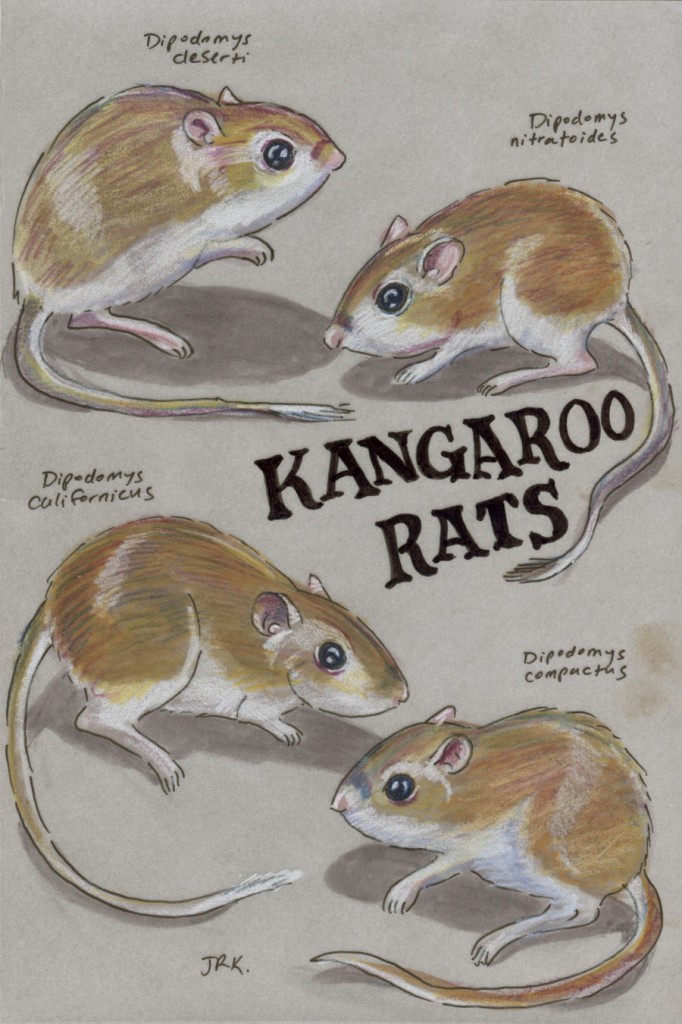
This all brings me to my new idea, which is: Random Rodents! I went to random.org, which generates random numbers, and told it to pick five numbers between 104 and 2278, which were the numbers of the undrawn rodents in my database when sorted by…whatever, you get it, yes? It picked 1789, 1873, 903, 1565, and 980, I researched the rodents associated with those numbers, and here they are!

Notice that we got lucky with the porcupine; the other five, although varying from 7 centimeters to 20 centimeters in length, look like quadruplets. Sure, some of them have long tails and some have slightly shorter tails, and some are ochraceous to tawny while others are tawny to ochraceous, but all in all, I could probably just spend a week drawing generic beige mouse-like critters and no one would know the difference.

The porcupine is Hystrix cristata, a North African crested porcupine. The others, top to bottom and left to right, are Leopoldamys sabanus, the long-tailed giant rat; Pelomys campanae, the bell groove-toothed swamp rat; Punomys lemminus, the puna mouse; and Reithrodontomys paradoxus, the Nicaraguan harvest mouse. I’ll try to do a Random Rodents drawing once a week and together, we’ll force our way through this rat’s nest.

{ 8 comments }

click image to enlarge

0228
0227
0226
0225
0230
0229

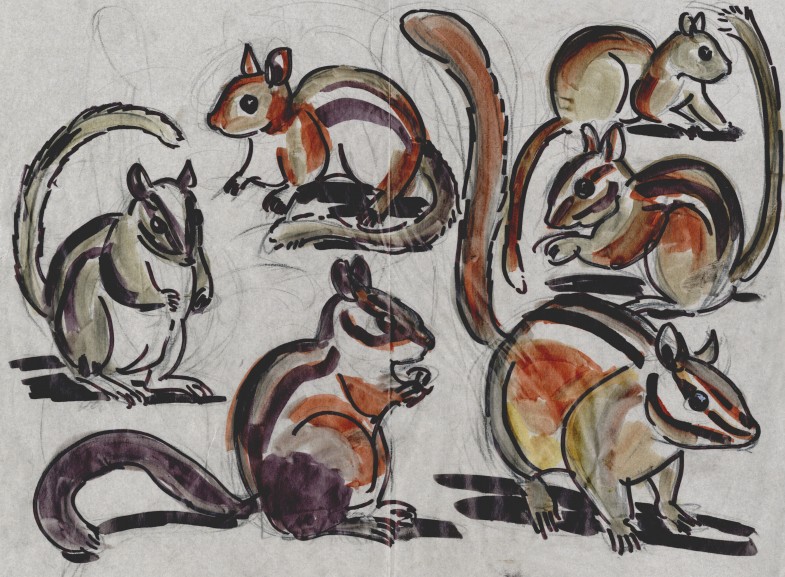
In one sense, I got lazy with this drawing, doing it in sharpie on top of my pencil with no shading, no blending, no colored pencil, and it’s on my tracing paper sketch instead of a nice crisp sheet of vellum. No furry details, no crazy colors. But if you knew how long I researched it and how many times I tried to draw it the normal way, you would know it wasn’t lazy at all. So here are six species of chipmunks from the Tamias genus. Clockwise from the top right: T. obscurus, T. quadrimaculatus, T. speciosus, T. senex, T. amoenus, and T. alpinus. All six species live in California.

Six more rodents! Check ‘em off if you’re scoring at home!

{ 0 comments }